How to Prevent Condensation Inside Outdoor Electrical Enclosures: Breather Drains, Heaters, and Sun Shields
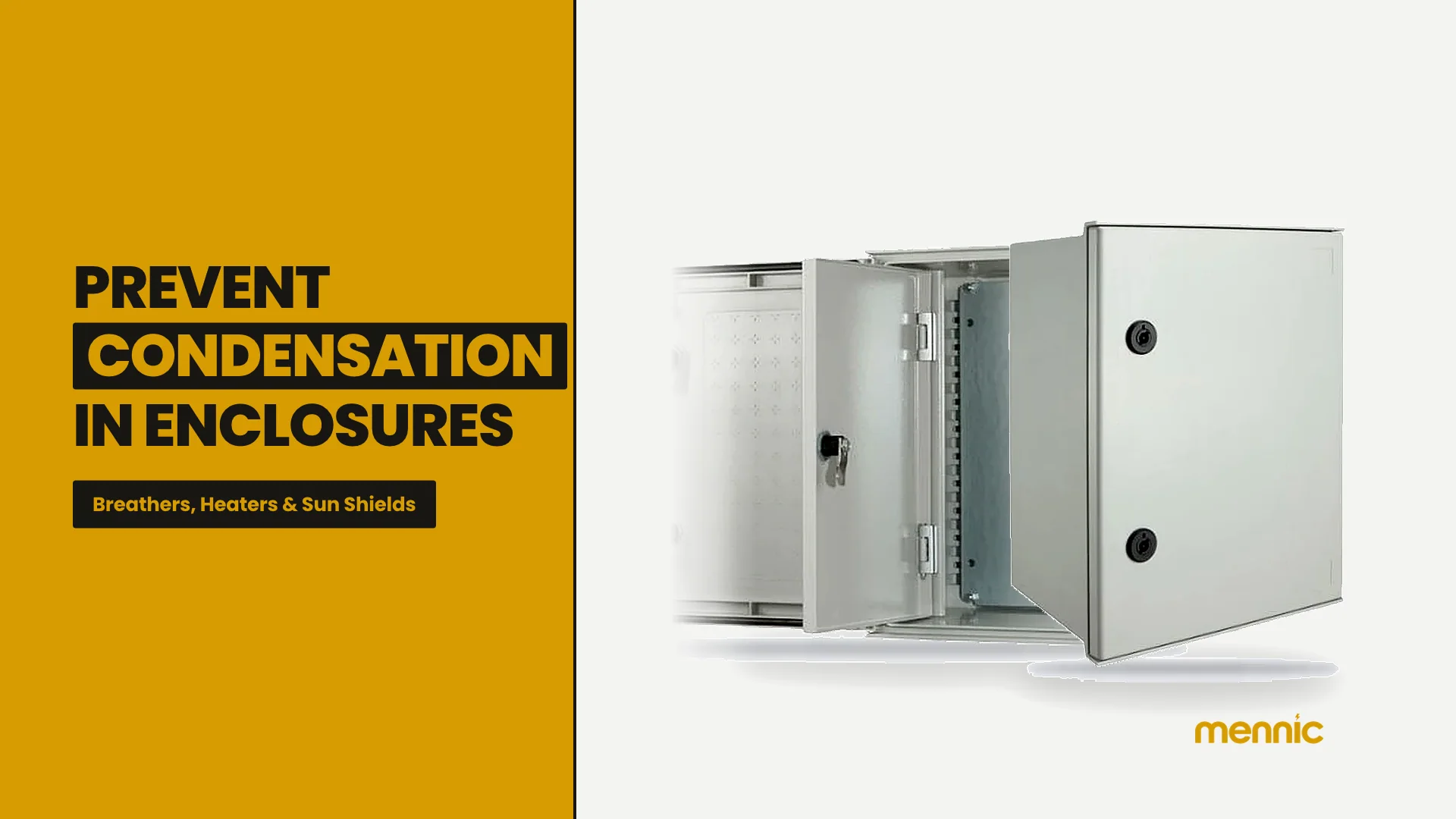
Condensation inside sealed IP65 and IP66 outdoor electrical enclosures occurs because daily solar heating and nighttime cooling create internal pressure swings of up to 10 kPa, drawing humid ambient air past cable entries and door gaskets until moisture condenses on cold inner walls. Preventing water accumulation requires combining pressure equalization via IP66/IP68 breather drains, passive solar shading, low-conductivity enclosure walls, and hygrostat-controlled PTC heaters.
Field engineers inspecting wet outdoor cabinets frequently suspect a defective door gasket when the real culprit is thermodynamics. Even a factory-verified IP66 weatherproof electrical enclosure designed to resist 100 L/min water jets under IEC 60529 cannot block water vapor molecules pulled inward by diurnal vacuum cycles—and once vapor condenses inside a tightly sealed cabinet with no drain path, pooled water accelerates terminal corrosion and insulation tracking.
Why Sealed IP65 and IP66 Enclosures Trap Moisture: The Breathing Effect
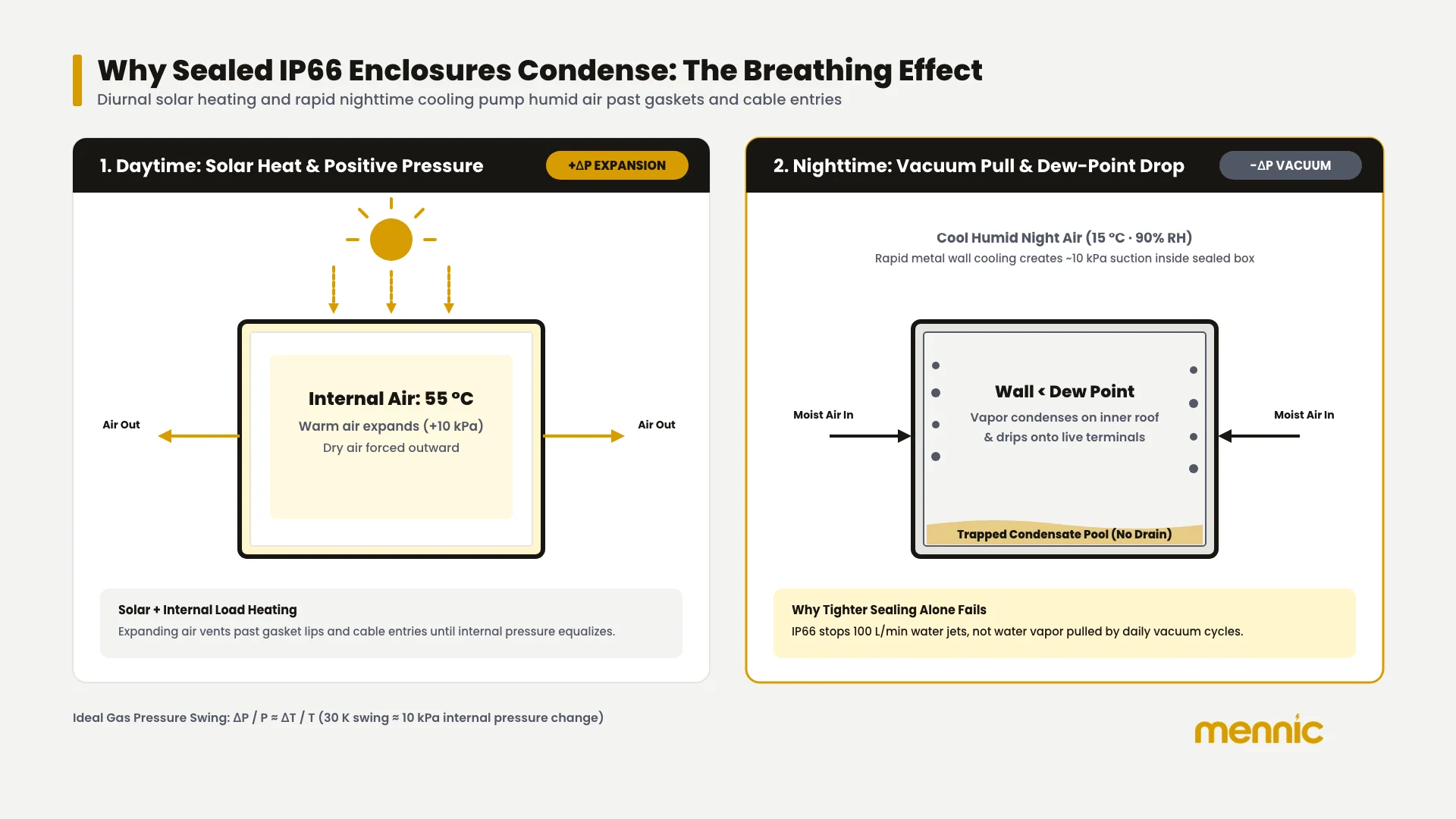
The enclosure breathing effect is driven by the ideal gas law (ΔP / P ≈ ΔT / T), where a 30 °C drop from daytime solar peak to nighttime ambient air generates roughly 10 kPa (100 mbar) of internal negative pressure inside a sealed cabinet. That vacuum forces moist night air through microscopic paths around cable entries, lock shafts, and gasket seams, depositing liquid condensate whenever interior surfaces fall below the local dew point.
During sunny outdoor operation classified under IEC 60721-3-4, direct solar irradiance combined with internal PLC or power-supply heat dissipation pushes air inside a closed box to 50–65 °C. Expanding warm air vents outward until internal pressure matches atmospheric pressure. After sunset—or during a sudden summer rainstorm—rapid cooling of the outer shell contracts the trapped air volume, creating suction that draws humid air inside.
Because standard IEC 60529 ingress testing verifies dust tightness and water-jet resistance rather than barometric pressure equalization (as explained in our IP65 vs IP66 electrical enclosures technical comparison), specifying a tighter seal without pressure relief actually worsens moisture accumulation: once liquid water condenses on the inner roof and drips onto terminal blocks, an unvented IP66 housing prevents it from ever escaping.
How Enclosure Wall Material Affects Dew-Point Condensation
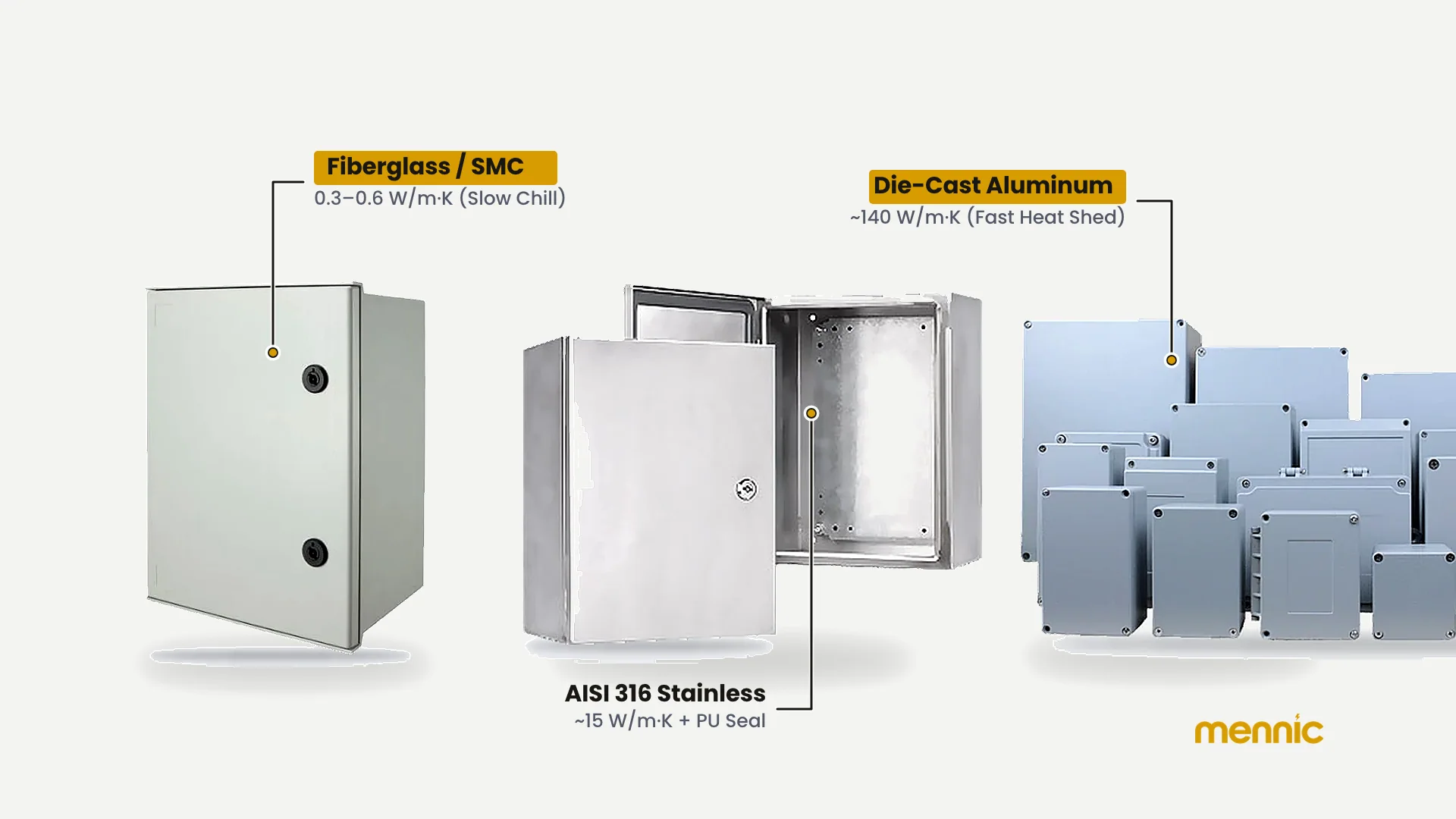
Enclosure wall thermal conductivity determines how quickly interior surfaces cool below the dew point after sunset or during cold rainfall. Metallic shells such as die-cast aluminum (120–160 W/m·K) and carbon steel (~50 W/m·K) track rapid ambient temperature drops almost immediately, whereas non-metallic fiberglass SMC (0.3–0.6 W/m·K) and polycarbonate (~0.20 W/m·K) act as thermal buffers that slow wall chilling and reduce condensation frequency.
| Enclosure Wall Material | Thermal Conductivity k (W/m·K) | Nocturnal Wall Cooling Speed | Condensation Risk (Unheated) | Best Outdoor Application Fit |
|---|---|---|---|---|
| Die-Cast Aluminum | 120–160 | Very fast | High without breather/heater | High-heat electronics needing passive heat shedding and EMI shielding |
| Cold-Rolled Carbon Steel (Powder-Coated) | ~45–55 | Fast | High in humid diurnal climates | General outdoor automation paired with rain hood and breather drain |
| AISI 304 / 316 Stainless Steel | ~15–16 | Moderate-fast | Moderate-high in coastal fog | Coastal, chemical, and washdown zones requiring corrosion immunity |
| Fiberglass / SMC (Glass-Fiber Polyester) | 0.30–0.60 | Slow (insulating) | Low-moderate | Coastal solar, telecom, and utility sites with large day-night swings |
| Polycarbonate / ABS Plastic | 0.18–0.22 | Slow (insulating) | Low-moderate | Compact sensor junctions and low-wattage outdoor distribution boxes |
Choosing fiberglass SMC enclosures or plastic and polycarbonate enclosures does not make a cabinet 100% immune to humidity over multi-day fog events, yet their 80× to 250× lower thermal conductivity compared to carbon steel dramatically dampens short-duration dew-point spikes. Conversely, high-wattage outdoor drives housed in die-cast aluminum industrial enclosures rely on high conductivity to shed heat during the day, making active pressure equalization and nighttime heating essential.
Comparing Four Anti-Condensation Defenses for Outdoor Enclosures
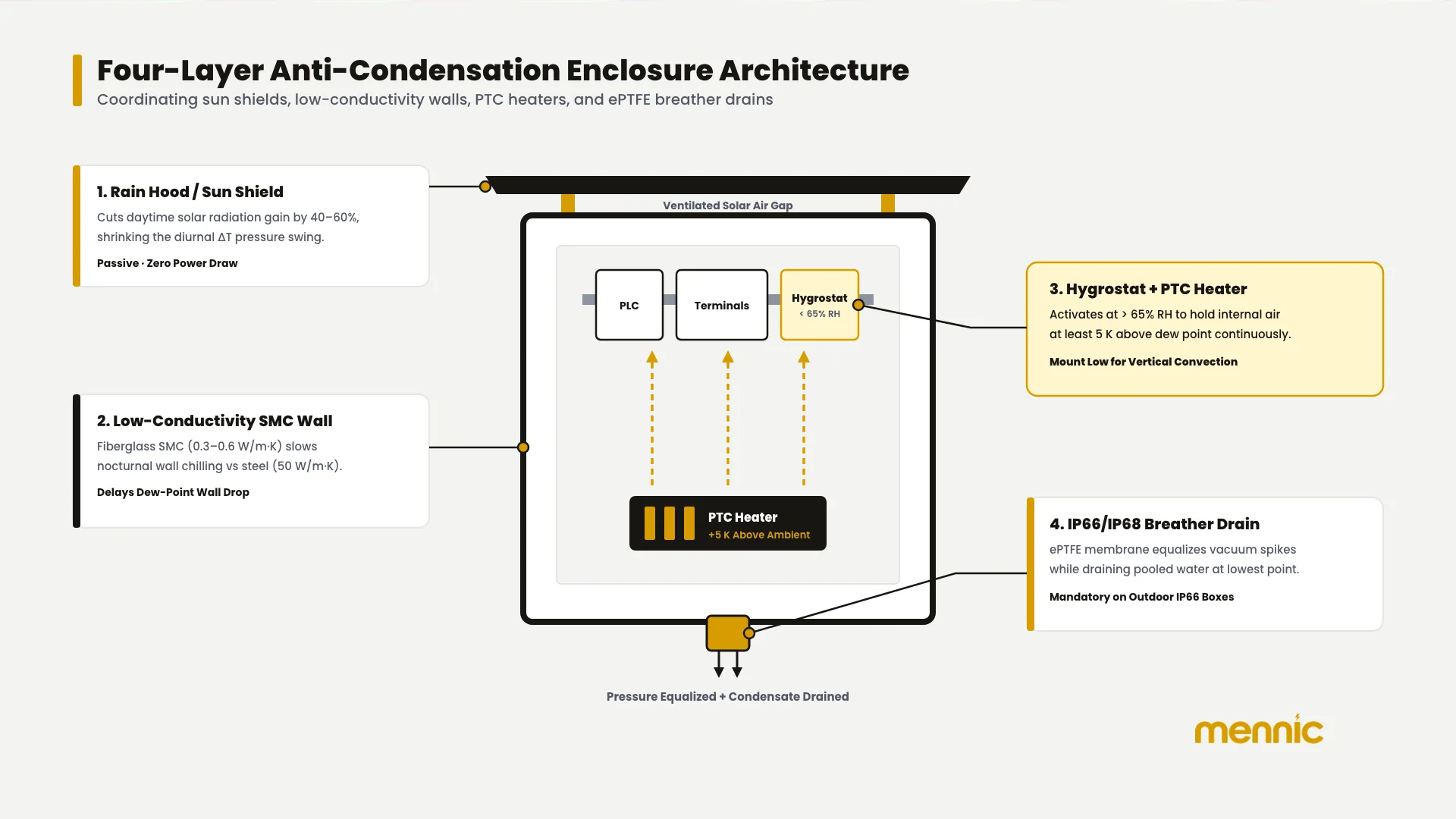
Reliable moisture control in outdoor electrical cabinets relies on matching four complementary engineering defenses—membrane breather drains, hygrostat-controlled PTC heaters, solar rain hoods, and insulating enclosure walls—to the site climate and available auxiliary power. No single device solves every outdoor failure mode; passive pressure equalization prevents vacuum suction, while active heating guarantees internal relative humidity stays below 65% RH during prolonged fog or freezing nights.
| Countermeasure | Operating Principle | Power Required | Preserves IP66 Rating | Best Used When |
|---|---|---|---|---|
| IP66/IP68 ePTFE Breather Drain | Hydrophobic membrane equalizes air pressure while draining liquid drops | None (passive) | Yes (when rated IP66/IP68) | Mandatory baseline on virtually all outdoor sealed enclosures |
| Rain Hood / Ventilated Sun Shield | Blocks direct solar irradiance and sheds rain away from top door gaskets | None (passive) | Yes (external overhang) | Direct-sun solar, utility, and street-side steel or stainless cabinets |
| Hygrostat + PTC Space Heater | Raises internal air temperature ≥ 5 K above ambient when RH exceeds 65% | 15–150 W AC/DC | Yes (internal DIN rail) | High-humidity coastal, tropical, or sub-zero sites with live controls |
| Fiberglass SMC / Polycarbonate Shell | Low thermal conductivity slows radiant wall cooling after sunset | None (passive) | Yes (molded IP65/IP66) | Unpowered remote telemetry, coastal solar, and corrosive utility sites |
How to Size an Anti-Condensation Heater and Place Breather Drains
Sizing an anti-condensation PTC heater follows the steady-state enclosure heat-transfer equation P_H = k × A × ΔT derived from IEC 60890 principles, where k is the enclosure wall heat-transfer coefficient (5.5 W/m²·K for painted steel, 3.5 W/m²·K for fiberglass SMC), A is the effective exposed surface area in m², and ΔT is the target temperature rise above ambient (typically 5 K to keep relative humidity safely below 65% RH).
For a typical wall-mounted 600 × 400 × 250 mm outdoor steel enclosure (exposed surface area A ≈ 0.74 m² when back-mounted on a wall), maintaining a 5 K anti-condensation margin requires P_H = 5.5 × 0.74 × 5 ≈ 20.4 W. Specifying a standard 30 W or 45 W DIN-rail PTC heater wired through a mechanical hygrostat set to 65% RH keeps the cabinet dry without overheating electronics during warm dry afternoons.
Correct mechanical placement matters just as much as wattage calculation:
- Mount the breather drain at the absolute lowest point: Install the IP66/IP68 breather drain on the bottom gland plate or floor panel with a clear gravity path so any incidental condensate exits immediately rather than pooling beside cable entries.
- Mount the PTC heater vertically near the bottom: Positioning the heater below DIN rails and terminal blocks creates a natural upward convection loop that sweeps warm dry air across cold doors and internal switchgear.
- Place the hygrostat in the upper third, away from the heater plume: Mounting a hygrostat directly above a heater causes premature shutoff before lower terminals dry out; install it on the upper side rail where cool moist air collects first.
- Avoid routing unsealed underground conduits into the cabinet: Damp underground trenches act as continuous vapor chimneys; always seal conduit entries with closed-cell duct seal or rated sealing plugs so ground humidity cannot bypass the enclosure’s moisture defenses.
Selecting Outdoor Mennic Enclosures Built for Moisture Control
Selecting an enclosure architecture engineered for outdoor weather exposure eliminates half the condensation battle before any internal accessories are wired. Mennic Electric supplies outdoor-ready housings across wall-mounting steel, fiberglass SMC, and stainless steel enclosure families tailored to outdoor solar and renewable energy and telecom and utility infrastructure deployments.
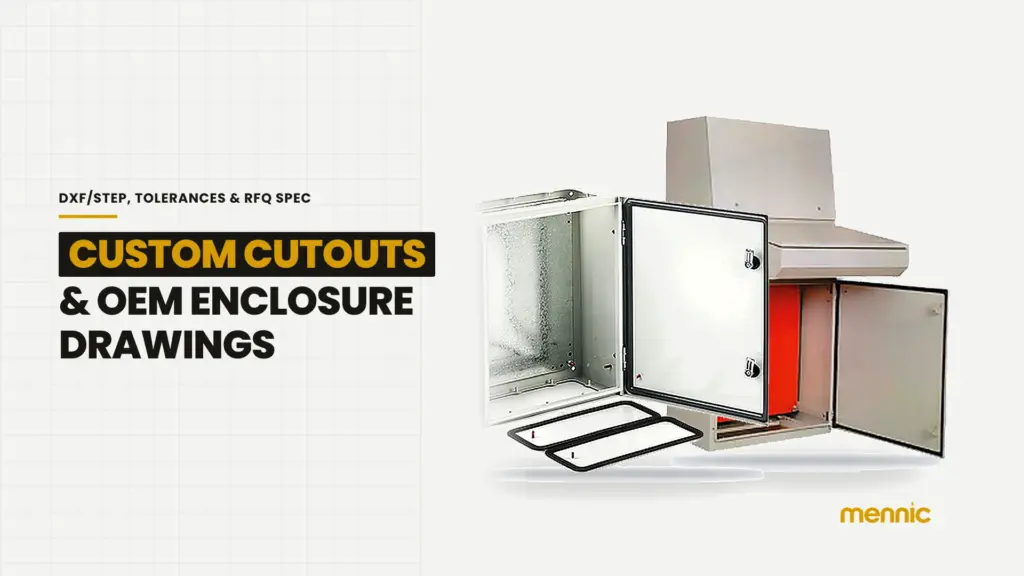
- Direct-sun industrial sites: The Outdoor Weather Hood Enclosure integrates an overhanging rain and solar canopy over an IP66 / IK10 powder-coated cold-rolled steel body with a continuous polyurethane door seal and waterproof riveted blind nuts for the bottom cable plate.
- High-humidity, coastal, and wireless solar sites: The Fiberglass Wall Mounting Enclosure and Fiberglass Enclosure with Inner Door use UV-stabilized SMC/FRP polyester shells that combine IP65/IP66 sealing, double electrical insulation, and low thermal conductivity to suppress nocturnal wall condensation.
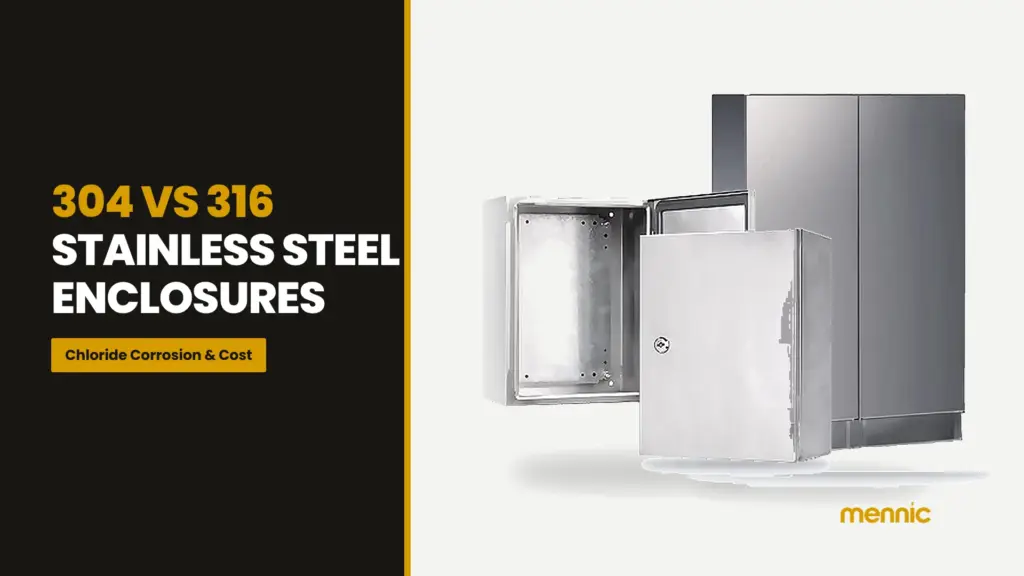
- Corrosive marine and coastal washdown sites: When metallic structural strength is required alongside moisture control, the Stainless Steel Enclosure pairs IP66 polyurethane gasketing with AISI 304 or AISI 316 construction—see our 304 vs 316 stainless steel enclosure selection guide for coastal chloride thresholds.
- Compact field sensor junctions: For small outdoor telemetry nodes where heaters are impractical, the Waterproof Junction Box in halogen-free ABS/polycarbonate delivers low thermal conductivity and IP65 environmental sealing.
If your outdoor panels require factory-punched breather drain holes, bottom gland-plate cutouts, or custom sun-shield sizing without compromising powder-coat or stainless passivation, Mennic manufacturing services can machine all openings prior to assembly. Share your ambient climate range, internal heat load, and mounting layout to contact the Mennic engineering team for sizing support.
Frequently Asked Questions
Does installing a breather drain lower an enclosure’s IP66 rating?
No, provided the breather drain itself is certified to IP66 or IP68 and installed with its sealing O-ring tightened to specification on a flat bottom surface. Hydrophobic ePTFE membranes allow air and water vapor molecules to pass freely for pressure equalization while blocking dust and high-pressure 100 L/min water jets under IEC 60529.
Are desiccant packets enough to prevent condensation in outdoor electrical enclosures?
Desiccant packs work only for short-term shipping or hermetically sealed indoor boxes, not permanent outdoor installations. Because daily temperature swings continually pump fresh humid air into outdoor enclosures, silica-gel packets saturate within weeks and stop absorbing moisture unless replaced on an impractical maintenance schedule.
Should an anti-condensation heater run continuously or through a hygrostat?
Always control an anti-condensation heater with a hygrostat (set to 60–65% RH) or a dual thermostat-hygrostat rather than running it continuously. Continuous operation wastes auxiliary energy and pushes daytime internal temperatures higher during summer solar peaks, shortening the electrolytic capacitor lifespan of PLCs and power supplies.
References
- IEC 60529 — Degrees of Protection Provided by Enclosures (IP Code)
- IEC 60890:2022 — A Method of Temperature-Rise Verification of Low-Voltage Switchgear and Controlgear Assemblies by Calculation
- IEC 62208:2023 — Empty Enclosures for Low-Voltage Switchgear and Controlgear Assemblies
- IEC 60721-3-4:2019 — Classification of Environmental Conditions: Stationary Use at Non-Weatherprotected Locations
- ISO 9223:2012 — Corrosion of Metals and Alloys: Corrosivity of Atmospheres Classification
Need help selecting the right enclosure?
Browse Enclosures
Explore our complete catalog of IP65/IP66 steel wall mounting cabinets and waterproof plastic distribution boxes.