NEMA 4X vs IP66 Enclosures: Outdoor Corrosion & Spec Guide
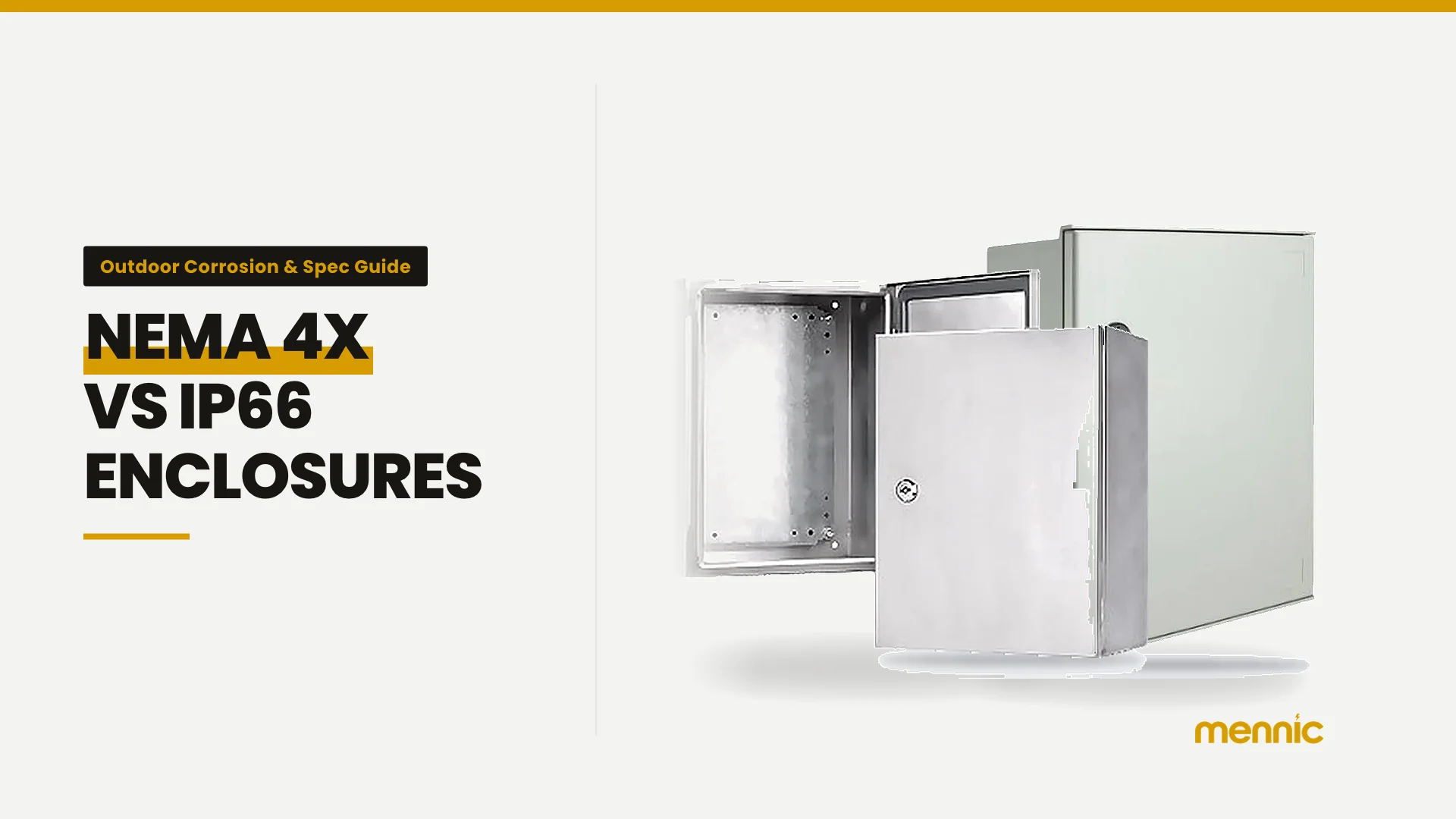
NEMA 4X and IP66 electrical enclosures both provide dust-tight sealing and resistance to powerful directional water jets, yet they are not one-to-one equivalents. IEC 60529 IP66 verifies solid-particle and 100 L/min water-jet ingress only, whereas NEMA 250 Type 4X adds mandatory 200-hour salt-spray corrosion testing, 20 mm external ice formation checks, and gasket-aging requirements that painted carbon steel IP66 boxes do not satisfy.
Engineers and global procurement teams frequently cross-reference North American NEMA 4X specifications against international IP66 weatherproof electrical enclosures when sourcing outdoor control cabinets. Treating IP66 as an automatic substitute for NEMA 4X is one of the most expensive specification errors in coastal, marine, and food-washdown projects—because an enclosure can pass IEC 60529 IP66 on day one and still rust through its door gasket flange within two years if the housing alloy is wrong.
Why IP66 Does Not Automatically Equal NEMA 4X
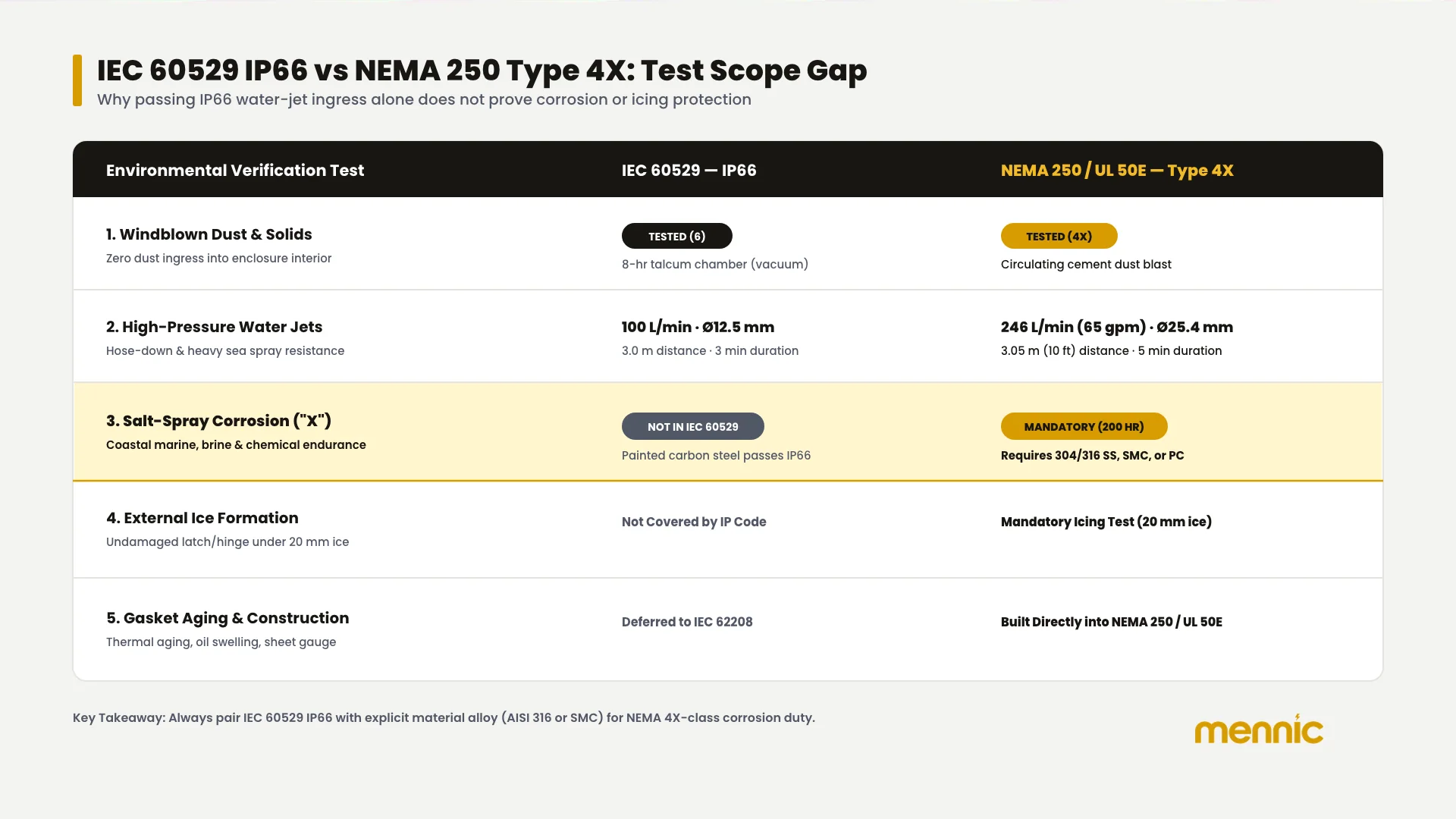
IEC 60529 and NEMA 250 measure fundamentally different scopes of environmental endurance. The IP66 rating evaluates solely whether dust or high-velocity water enters the housing during a short laboratory spray test, while the X suffix in NEMA Type 4X mandates proven resistance to corrosive agents, external icing, and long-term gasket degradation under NEMA 250 and UL 50E.
| Verification Parameter | IEC 60529 — IP66 | NEMA 250 / UL 50E — Type 4X | Practical Engineering Impact |
|---|---|---|---|
| Dust-Tight Verification | 8-hour talcum powder chamber (vacuum optional) | Circulating cement-dust blast (no ingress) | Both grades protect switchgear from fine industrial dust |
| Water-Jet Flow Rate | 100 L/min (~26.4 gpm) | 246 L/min (65 gpm) | NEMA 4X delivers ~2.5× higher water volume during hose-down |
| Test Nozzle & Distance | Ø12.5 mm nozzle at 2.5–3.0 m for 3 min | Ø25.4 mm (1 in) nozzle at 3.05 m (10 ft) for 5 min | Both require continuous compressed PU or silicone door gaskets |
| Corrosion Resistance (“X”) | Not tested under IEC 60529 | Mandatory 200-hour salt-spray or moist CO2-SO2 test | Painted carbon steel passes IP66 but fails Type 4X corrosion |
| External Ice Formation | Not tested under IEC 60529 | Mandatory 20 mm (0.75 in) ice-load test without damage | Validates latches, hinges, and seals in freezing outdoor climates |
| Construction & Gasket Aging | Deferred to IEC 62208 | Built directly into NEMA 250 / UL 50E | IEC projects must specify IEC 62208 + alloy alongside IP66 |
Because IEC 60529 deliberately separates ingress protection from mechanical impact (IEC 62262 IK ratings) and atmospheric corrosion (ISO 9223), a complete international specification equivalent in durability to NEMA 4X always states three distinct lines: IP66 ingress protection, IK10 mechanical impact, and a corrosion-proof housing material such as AISI 316 stainless steel or fiberglass SMC.
The Painted Carbon Steel Trap in Coastal and Washdown Specifications
Powder-coated cold-rolled carbon steel electrical enclosures readily achieve IEC 60529 IP66 sealing through continuous foamed-in-place polyurethane gaskets and folded rain gutters, yet painted carbon steel fails corrosive Type 4X service as soon as scratches, field cutouts, or lock-barrel abrasion expose bare iron to chloride moisture. Specifying an IP66 carbon steel box for a coastal port or chlorinated food plant creates a false sense of protection.
In dry indoor workshops or sheltered inland automation corridors, cold-rolled carbon steel electrical enclosures with textured RAL 7035 epoxy-polyester powder coating remain the most cost-effective IP66 solution. However, once airborne sea salt (ISO 9223 Class C4–C5) or warm sodium-hypochlorite washdown enters the picture, under-film rust creeps outward from hinges, rivets, and door lips, breaking gasket compression and voiding IP66 protection well before the switchgear reaches end of life.
For projects comparing water-jet levels before deciding on material grade, review our IP65 vs IP66 electrical enclosures engineering comparison to confirm whether 12.5 L/min (IP65) or 100 L/min (IP66) sealing is required first, then lock the corrosion-resistant substrate separately.
Matching Housing Materials to IP66 and Type 4X Corrosion Duty
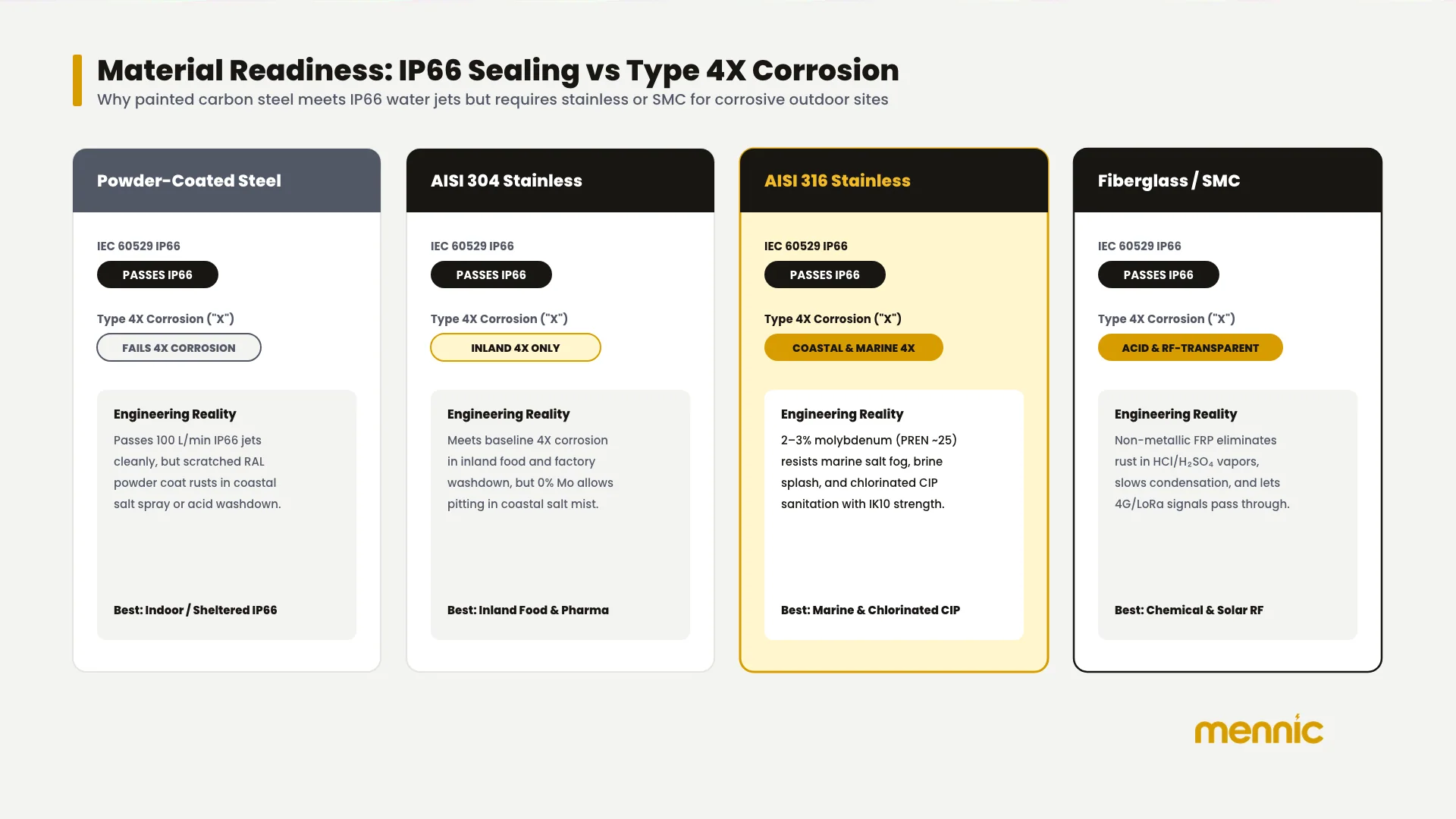
Achieving both high-pressure water-jet sealing and long-term corrosion immunity requires selecting an inherently corrosion-resistant enclosure shell—specifically AISI 304 stainless steel for inland washdown, AISI 316 stainless steel for marine and chlorinated environments, or fiberglass SMC for strong acid vapors and wireless telemetry. Each material pairs differently with IP66 gasketing and outdoor thermal stresses.
| Enclosure Material | Passes IEC 60529 IP66 | Corrosion Readiness (4X-Class Duty) | Best Outdoor / Corrosive Application | Key Limitation to Watch |
|---|---|---|---|---|
| Powder-Coated Carbon Steel | Yes | Fails coastal / chemical corrosion | Indoor automation, dry MEP, sheltered outdoor with rain hood | Scratches and cutout edges rust in salt fog |
| AISI 304 / 304L Stainless Steel | Yes | Suitable for inland non-chlorinated washdown | Inland dairy, bakery, pharmaceutical, clean industrial | 0% Mo allows gasket-crevice pitting in marine air |
| AISI 316 / 316L Stainless Steel | Yes | High marine, brine, and chlorinated CIP resistance | Coastal (< 5 km), offshore, seafood/meat CIP, chemical washdown | +20–35% alloy premium over AISI 304 |
| Fiberglass / SMC (FRP Polyester) | Yes | Immune to salt fog, HCl/H2SO4 vapor, and UV | Coastal solar, chemical plants, pole-mount wireless telemetry | Lower EMI shielding than metallic housings |
| Die-Cast Aluminum Alloy | Yes | Good atmospheric durability; sensitive to raw alkali/brine | Compact IK10 field sensors, EMI-shielded outdoor instrumentation | Requires protective coating in marine salt splash |
If your site falls on the boundary between inland washdown and coastal salt mist, compare PREN pitting thresholds in our 304 vs 316 stainless steel electrical enclosures guide, or test your exact site parameters directly in the interactive Mennic Material & IP Selector.
How to Write an Unambiguous Outdoor Corrosion Specification
Writing a clean international procurement specification eliminates supplier guesswork by explicitly defining ingress sealing, mechanical impact, housing alloy, condensation control, and required regional certification marks on separate lines. When a North American project legally mandates a third-party UL 50E / NEMA 4X listed enclosure under local electrical inspection, that listing must be specified upfront; for IEC-governed global installations, combining IEC 60529 IP66, IEC 62208 construction, and explicit material grades delivers equivalent field durability without unnecessary certification markups.
Include five concrete line items in every outdoor corrosive enclosure RFQ:
- Ingress & Impact Standard: Specify IEC 60529 IP66 (100 L/min water jets) and IEC 62262 IK10 mechanical impact resistance, or explicitly state if UL 50E / NEMA 4X third-party listing is contractually required by the local Authority Having Jurisdiction (AHJ).
- Exact Substrate & Grade: Never write generic stainless steel or plastic—specify AISI 304L, AISI 316L, UV-stabilized fiberglass SMC, or powder-coated cold-rolled steel with sheet thickness (1.2 mm, 1.5 mm, or 2.0 mm).
- Gasket & Hardware Compatibility: Require continuous foamed-in-place polyurethane (PU) door seals and stainless steel latches/fasteners in coastal or washdown zones to avoid galvanic rust at hinges and lock barrels.
- Condensation & Pressure Control: Pair outdoor IP66 housings with a bottom-mounted IP66/IP68 breather drain and, in humid diurnal climates, a hygrostat-controlled PTC heater—sized in minutes with our Outdoor Anti-Condensation Heater Calculator and detailed in our outdoor condensation prevention guide.
- Pre-Finish Factory Cutouts: Specify all meter, gland-plate, and breather openings via 2D DXF before powder coating or stainless steel passivation to avoid field-drilled corrosion points.
Corrosion-Resistant IP66 Enclosure Options from Mennic Electric
Mennic Electric manufactures IEC 60529 IP66 and IEC 62208-engineered electrical enclosures across corrosion-resistant Stainless Steel, Fiberglass / SMC, and die-cast aluminum families tailored for food, beverage, and corrosive washdown and outdoor solar and coastal installations.
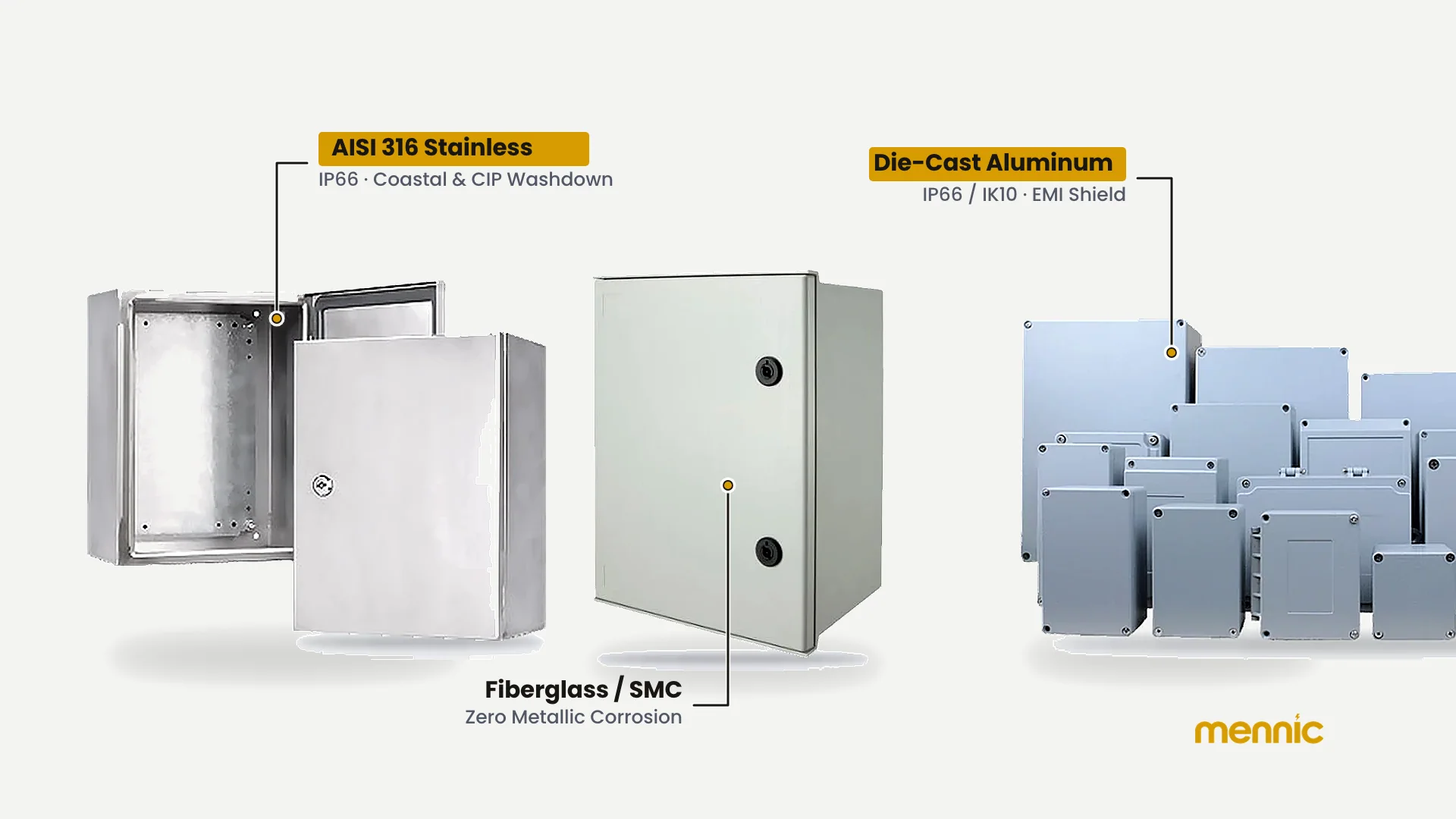
- Coastal & Washdown Wall-Mount: The Stainless Steel Enclosure combines brushed AISI 304 or AISI 316 sheet steel with a continuous polyurethane door seal, bar lock, and galvanized steel mounting plate rated to IP66.
- High-Density Corrosive Cabinets: The Stainless Steel Floor Standing Cabinet (Single Door) delivers full-height IP66 protection on 9-folded stainless rails with MS821-X locking and removable bottom cable entry.
- Acid-Proof & Wireless Coastal Housings: The Fiberglass Wall Mounting Enclosure and Fiberglass Enclosure with Inner Door provide UV-stabilized, non-metallic SMC/FRP protection with double electrical insulation and RF transparency.
- Sheltered Outdoor & Compact EMI Housings: For inland direct-sun sites without heavy salt spray, the Outdoor Weather Hood Enclosure shields IP66 gaskets from solar heat and rain, while the Die-Cast Aluminum Industrial Enclosure provides IP66 / IK10 strength with natural EMI shielding.
Share your regional standard requirements, chloride exposure, and cutout drawings to contact the Mennic engineering team for material recommendations and dimensional drawings.
Frequently Asked Questions
Can an IP66 enclosure always replace a NEMA 4X enclosure?
No, an IP66 rating alone only verifies dust tightness and 100 L/min water-jet resistance under IEC 60529—it does not verify salt-spray corrosion resistance, external ice formation, or North American UL 50E third-party listing. To match NEMA 4X field durability in IEC projects, pair IP66 sealing with AISI 316 stainless steel or fiberglass SMC materials.
Does NEMA 4X automatically meet IP66 requirements?
In general field performance, NEMA 4X meets or exceeds IP66 for dust and hose-down water resistance (testing at 246 L/min versus 100 L/min), and adds corrosion and icing protection. However, because IEC 60529 and NEMA 250 use different test procedures and official equivalence is not legally automatic, projects mandating IEC 60529 documentation still require IP66 test verification.
What is the difference between NEMA 4 and NEMA 4X?
NEMA 4 and NEMA 4X share identical dust-tight, rain-tight, hose-down (65 gpm), and external icing protection requirements, but NEMA 4X adds mandatory corrosion resistance (the X suffix). Powder-coated carbon steel enclosures can meet NEMA 4 for outdoor rain exposure, whereas NEMA 4X requires corrosion-resistant materials such as 304/316 stainless steel, fiberglass SMC, or polycarbonate.
References
- NEMA 250 — Enclosures for Electrical Equipment (1000 Volts Maximum)
- IEC 60529 — Degrees of Protection Provided by Enclosures (IP Code)
- IEC 62208:2023 — Empty Enclosures for Low-Voltage Switchgear and Controlgear Assemblies
- UL 50E — Enclosures for Electrical Equipment, Environmental Considerations
- ISO 9223:2012 — Corrosion of Metals and Alloys: Corrosivity of Atmospheres Classification
Need help selecting the right enclosure?
Browse Enclosures
Explore our complete catalog of IP65/IP66 steel wall mounting cabinets and waterproof plastic distribution boxes.