304 vs 316 Stainless Steel Electrical Enclosures: Chloride Corrosion, Cost, and Selection
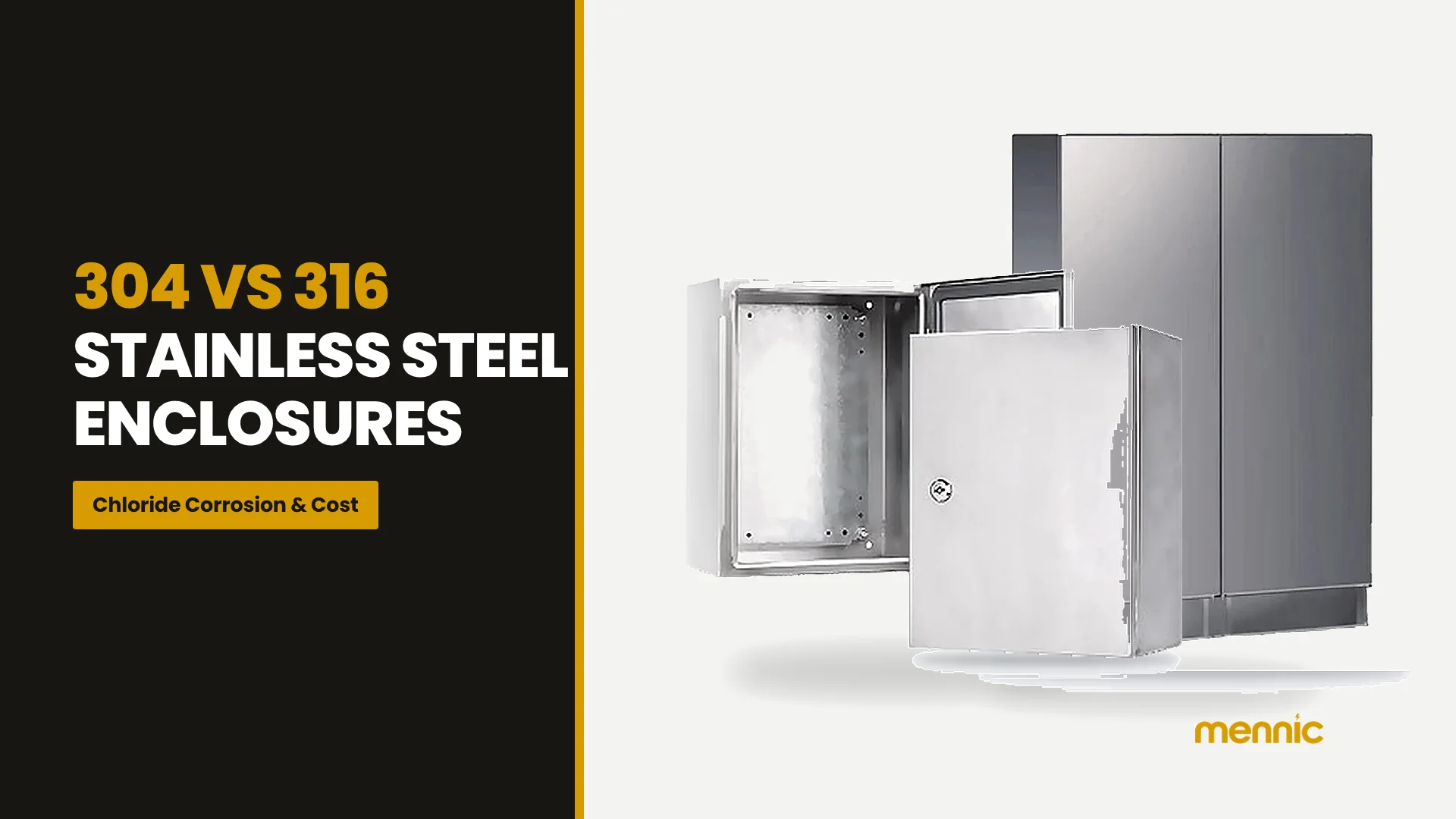
AISI 304 and AISI 316 stainless steel electrical enclosures share nearly identical mechanical strength, formability, and IP66 water-jet sealing capability, yet AISI 316 adds 2.0 to 3.0% molybdenum to resist chloride-induced pitting and crevice corrosion. Specifying AISI 304 for inland automation and non-chlorinated washdown controls upfront capital cost, while coastal air, brine splash, and chlorinated CIP sanitation mandate AISI 316 to avoid premature gasket-groove perforation.
For panel builders and plant engineers sourcing stainless steel electrical enclosures, the wrong alloy grade rarely fails across flat door panels first. Instead, corrosion initiates silently inside stagnant crevices—under polyurethane door gaskets, around quarter-turn latch barrels, and behind wall-mounting brackets—where trapped salt mist or sanitizer evaporates into concentrated chloride brines.
Alloy Chemistry and PREN Pitting Resistance of AISI 304 vs AISI 316
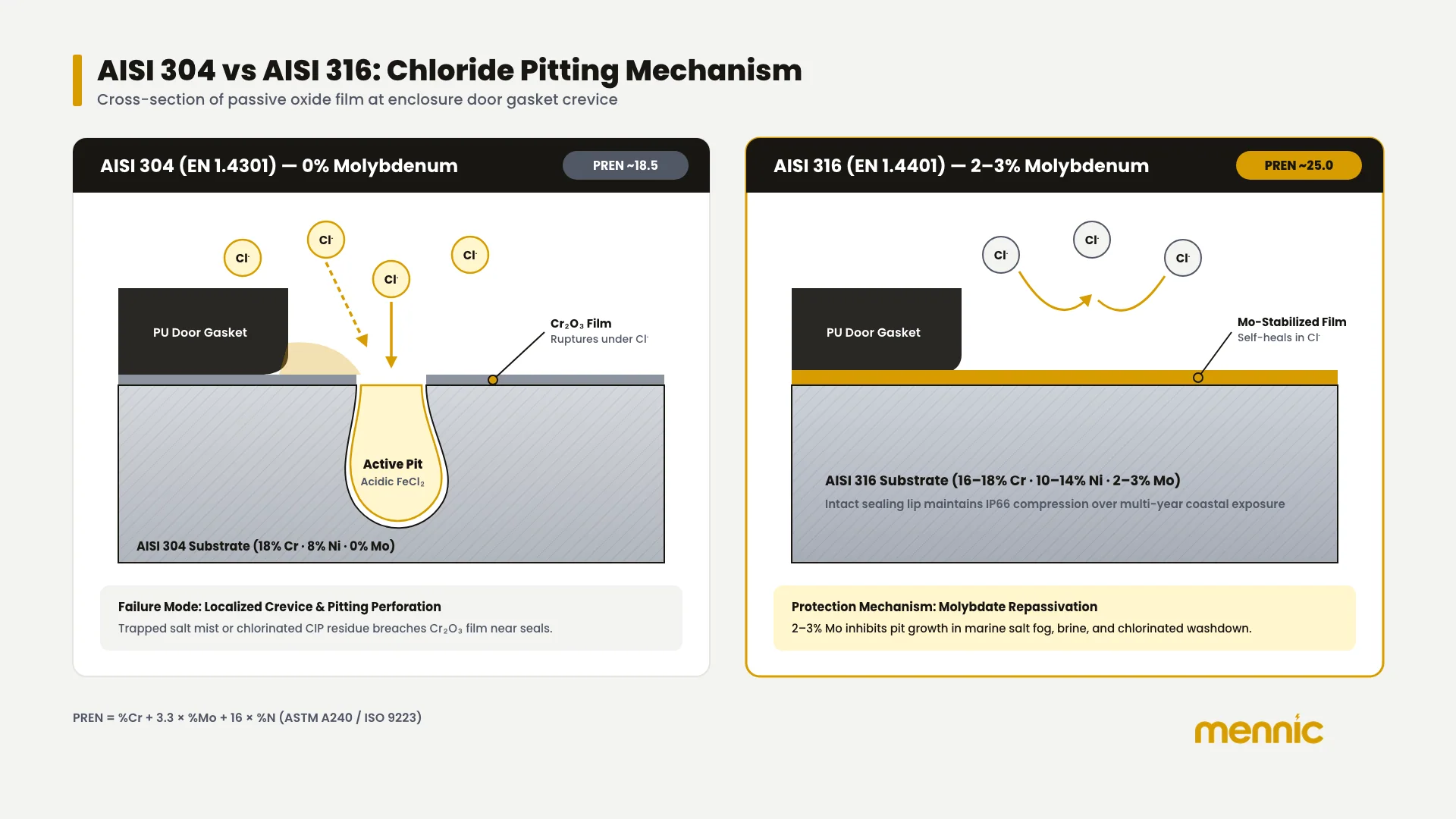
AISI 304 (EN 1.4301) and AISI 316 (EN 1.4401) are austenitic chromium-nickel stainless steels governed by ASTM A240, differentiated primarily by molybdenum content and higher nickel stabilization in AISI 316. Adding 2.0 to 3.0% molybdenum raises the Pitting Resistance Equivalent Number (PREN) from roughly 18.5 in AISI 304 to approximately 25.0 in AISI 316, directly increasing the chloride threshold required to rupture the passive chromium-oxide film.
Engineers quantify localized pitting resistance using the standard austenitic formula PREN = %Cr + 3.3 × %Mo + 16 × %N. Because molybdenum carries a 3.3× multiplier relative to chromium, even a 2.5% molybdenum addition produces a step-change in resistance to halide ions (Cl⁻ and Br⁻) without altering bending radii or weld fabrication tolerances in sheet-metal enclosures.
| Metallurgical Parameter | AISI 304 / 304L (EN 1.4301 / 1.4307) | AISI 316 / 316L (EN 1.4401 / 1.4404) | Engineering Impact on Enclosures |
|---|---|---|---|
| Chromium (Cr, wt%) | 17.5–19.5% | 16.0–18.0% | Forms baseline self-healing Cr2O3 passive film |
| Nickel (Ni, wt%) | 8.0–10.5% | 10.0–14.0% | Stabilizes austenitic structure during deep door bends |
| Molybdenum (Mo, wt%) | 0% | 2.0–3.0% | Suppresses chloride pit initiation and crevice propagation |
| Max Carbon (304 / 316 vs L-Grade) | 0.08% (304) / 0.03% (304L) | 0.08% (316) / 0.03% (316L) | L-grades prevent carbide precipitation at TIG-welded corners |
| Typical PREN Range | 18.0–19.5 | 23.5–26.0 | +5.5 to +7.5 PREN margin against coastal and CIP chlorides |
| Typical Critical Pitting Temp (ASTM G48) | ~10–15 °C | ~20–25 °C | Higher temperature tolerance during hot washdown cycles |
| Relative Enclosure Material Cost | Baseline (1.00×) | +20% to +35% | Premium driven by global nickel and molybdenum surcharges |
Selecting AISI 304L or AISI 316L low-carbon sheet becomes critical whenever enclosure corners, rain gutters, or internal mounting studs are continuously TIG-welded, because keeping carbon at or below 0.03% eliminates intergranular chromium depletion in the heat-affected zone.
Why Electrical Enclosures Pit at Gasket Crevices Before Flat Panels
Stainless steel electrical enclosures fail from localized crevice corrosion along sealing interfaces long before general surface rust appears on vertical doors. When salt fog, brine droplets, or chlorinated washdown water wick beneath a compressed polyurethane door gasket or behind a mounting bracket, oxygen depletion prevents the Cr2O3 passive layer from self-healing, creating an acidic iron-chloride micro-cell that drills through 1.2 mm or 1.5 mm sheet metal.
Flat-sheet corrosion coupons tested in clean laboratory immersion frequently overstate the field lifespan of AISI 304 cabinets. Real industrial housings contain four structural chloride traps that accelerate corrosion:
- Door gasket compression lips: Continuous foamed-in-place polyurethane (PU) gaskets seal out water jets under IEC 60529, yet the outer edge of the folded gutter lip collects evaporating mist that leaves crystalline NaCl deposits right beside the seal.
- Quarter-turn cam locks and hinge pins: Narrow annular clearances around lock barrels and concealed hinge sleeves restrict oxygen diffusion while retaining washdown detergent.
- Wall-mounting bracket interfaces: Standoff brackets bolted directly to rear enclosure walls trap moisture between dissimilar or tightly mated surfaces unless isolated with polymeric washers.
- Unpassivated field cutouts: Drilling cable-entry holes on site with carbon-steel hole saws embeds free iron particles into the stainless edge, triggering immediate tea-staining and pitting unless the cutout is deburred and re-passivated.
Remember that an IP66 weatherproof enclosure rating verifies dust tightness and resistance to 100 L/min water jets under IEC 60529, not chemical corrosion resistance. As detailed in our IP65 vs IP66 electrical enclosures engineering comparison, maintaining long-term ingress protection requires both an intact PU gasket and an unpitted metal sealing flange—once pitting roughens the knife-edge lip on an AISI 304 box, IP66 compression integrity is lost.
Coastal, Chemical, and Food Washdown Selection Boundaries
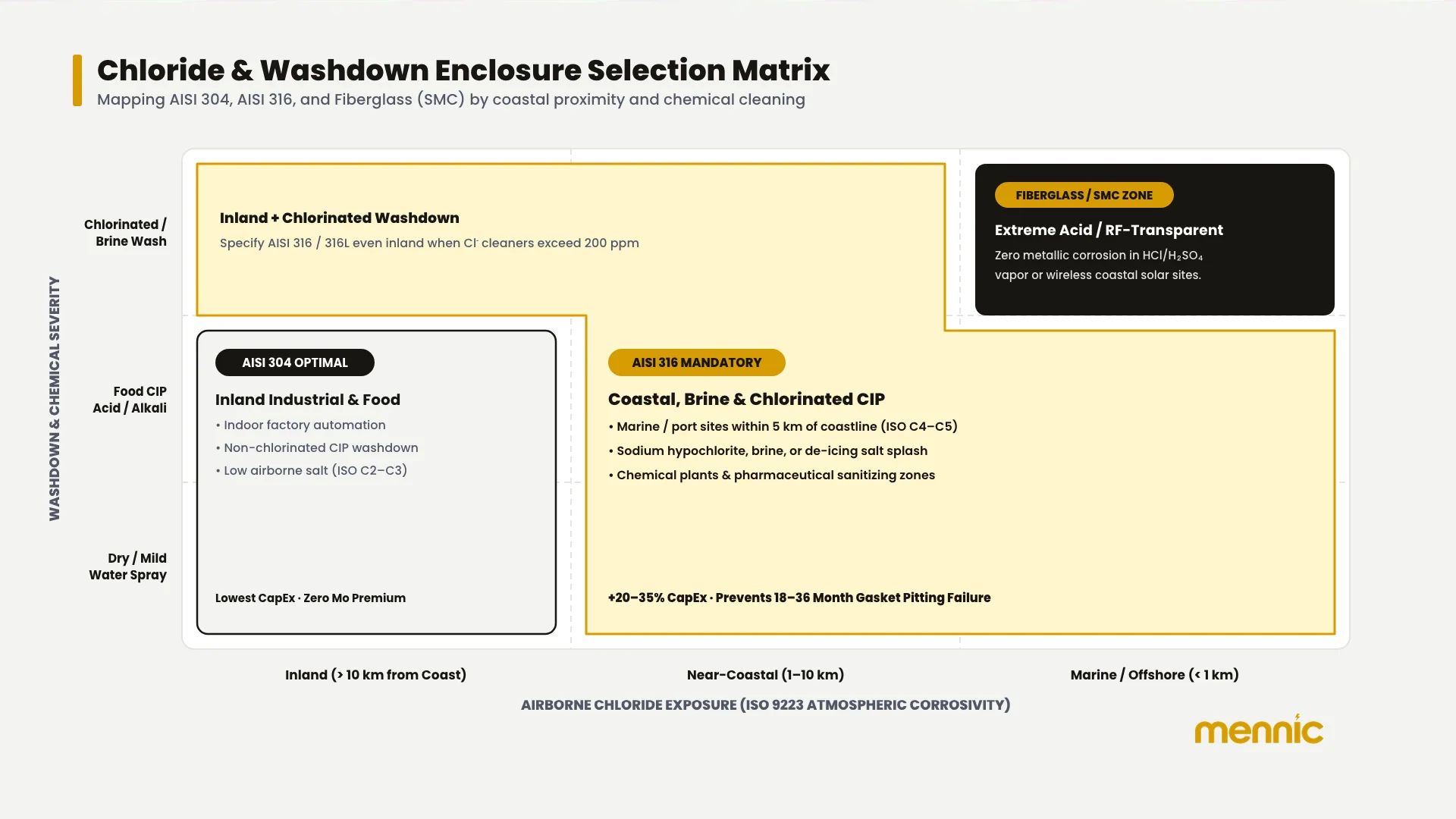
Selecting between AISI 304 and AISI 316 electrical enclosures depends on airborne chloride deposition classified under ISO 9223 and the active halogen concentration of plant cleaning regimes. Facilities located more than 10 km inland using dry air or non-chlorinated alkaline/acid CIP washes operate reliably with AISI 304, whereas sites within 5 km of saltwater coastlines or exposed to sodium hypochlorite, brine, or de-icing salts require AISI 316.
| Operating Environment | Typical Chloride / Chemical Stress | ISO 9223 Class | Recommended Grade | Key Engineering Rationale |
|---|---|---|---|---|
| Inland factory automation and PLC rooms | Low airborne salt, occasional water spray | C2–C3 | AISI 304 | Unnecessary to pay 20–35% molybdenum premium in low-chloride air |
| Dairy, bakery, and beverage CIP (non-chlorinated) | Warm caustic/peracetic acid washdown, low Cl⁻ | C3 | AISI 304 / 304L | Resists organic food acids and nitric/phosphoric CIP cycles cleanly |
| Meat, seafood, and brining lines | Sodium hypochlorite (> 200 ppm Cl⁻), salt brine | C4–C5 | AISI 316 / 316L | Prevents rapid crevice pitting under gaskets and lock barrels |
| Near-coastal outdoor sites (1–5 km from sea) | Windborne sea-salt aerosols, cyclic dew drying | C4 | AISI 316 | Evaporative salt concentration on warm cabinet doors breaks down 304 |
| Ports, offshore platforms, desalination (< 1 km) | Heavy marine salt spray, persistent wet film | C5–CX | AISI 316 / 316L | Mandatory baseline metallic grade; pair with regular freshwater rinsing |
| Chemical plants with HCl / H2SO4 vapor | Reducing mineral acids that attack austenitic steel | CX | Fiberglass / SMC | Non-metallic composite avoids metallic pitting entirely |
Engineers specifying food, beverage, and corrosive washdown enclosures must audit the exact sanitizer chemistry rather than assuming all food plants behave identically. A dry grain packaging hall performs cleanly with AISI 304 for decades, while a poultry or seafood washdown line spraying chlorinated foam at 50–60 °C can initiate visible rust streaks around AISI 304 lock housings within 12 to 24 months.
When Fiberglass SMC or Carbon Steel Outperforms Stainless Steel
Neither AISI 304 nor AISI 316 is universally optimal when project constraints involve strong reducing acids, wireless telemetry transmission, or strict indoor budget limits. In non-corrosive indoor MEP and automation rooms, powder-coated cold-rolled carbon steel electrical enclosures deliver equal IP66 protection at substantially lower cost, while extreme chemical vapors and coastal wireless nodes often perform better inside non-metallic fiberglass SMC enclosures.
Consider three boundary conditions before locking in stainless steel across an entire bill of materials:
- Strong reducing acids and stagnant brine pools: Concentrated hydrochloric acid, hydrofluoric acid, or warm acidic ferric-chloride mist attacks even AISI 316 over time. Glass-fiber reinforced polyester (SMC) housings are chemically inert to these vapors and eliminate metallic pitting altogether.
- Coastal solar and wireless telemetry: In outdoor, solar, and renewable energy enclosures housing cellular modems, LoRaWAN gateways, or Wi-Fi bridges, stainless steel acts as a Faraday cage requiring external bulkhead antennas. UV-stabilized SMC enclosures allow internal antennas while resisting marine salt fog at lower mounting weight.
- Climate-controlled indoor control rooms: For clean indoor industrial automation control panels free of corrosive washdown, upgrading from powder-coated steel to AISI 304 adds cost without improving ingress sealing or structural stiffness.
Total Cost of Ownership: Weighing the 20–35% AISI 316 Premium
AISI 316 electrical enclosures typically carry a 20 to 35% purchase-price premium over dimensionally identical AISI 304 units due to alloy nickel and molybdenum surcharges, yet enclosure metal represents a minor fraction of total installed panel cost. In coastal or chlorinated-washdown facilities, a single premature cabinet replacement—including PLC rewiring, commissioning labor, and unplanned line downtime—exceeds the initial AISI 316 alloy upgrade by five to ten times.
| Cost and Lifecycle Dimension | AISI 304 in Mild Inland Service | AISI 304 in Coastal / Chlorinated Site | AISI 316 in Coastal / Chlorinated Site |
|---|---|---|---|
| Upfront Empty Enclosure CapEx | Baseline (1.00×) | Baseline (1.00×) | 1.20×–1.35× |
| Share of Wired Control Panel Cost | Typically 8–15% of total panel | Typically 8–15% of total panel | Typically 10–18% of total panel |
| Typical Crevice / Gasket Integrity Life | 15+ years | 1.5–4 years before flange pitting | 10–15+ years with routine rinsing |
| Rewiring & Unplanned Downtime Risk | Very low | High (corrosion breaches IP66 seal) | Low |
| 10-Year Total Cost of Ownership Verdict | Lowest TCO (optimal choice) | Highest TCO (false economy) | Lowest TCO (protects live controls) |
Procurement teams can optimize project budgets without risking field failures by zoning the facility bill of materials rather than applying one alloy plant-wide. Specify AISI 304 for dry packaging rooms, upper mezzanines, and inland control corridors, while isolating AISI 316 strictly to coastal outdoor runs, brine-handling skids, and chlorinated washdown zones.
Matching Mennic Stainless Steel Enclosure Series to Site Conditions
Mennic Electric manufactures seven dedicated series within the Stainless Steel Enclosures catalog, spanning compact 1.2 mm terminal boxes, IP66 wall-mounting control boxes, and 9-folded floor-standing industrial cabinets available in AISI 304/304L and AISI 316 configurations. Selecting the right mechanical architecture alongside the right alloy grade ensures both corrosion immunity and ergonomic field maintenance.
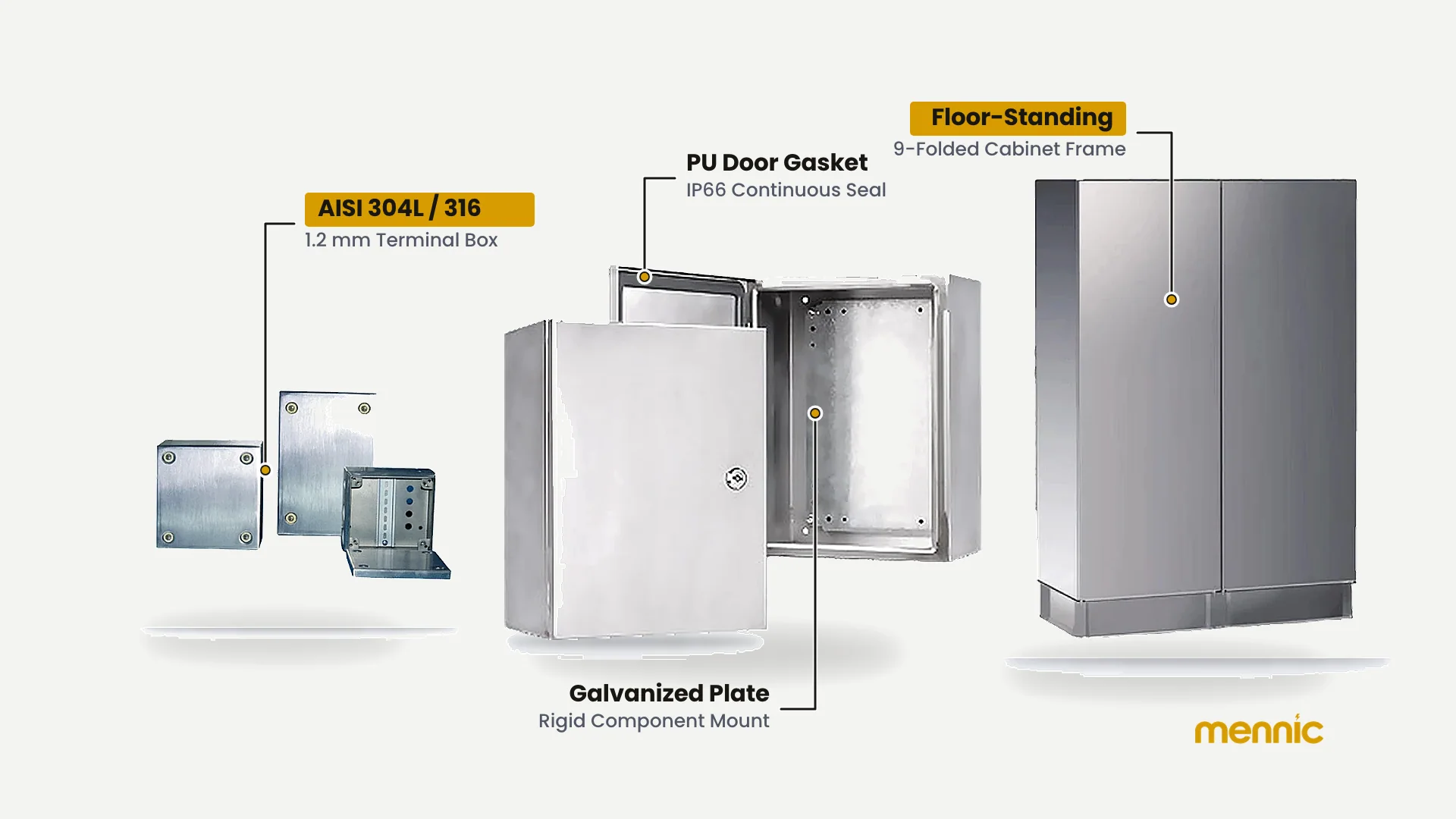
- Compact field junctions: The Stainless Steel Terminal Box is fabricated from 1.2 mm AISI 304L (with AISI 316 available on request) and secured with stainless steel cover screws for sensor junctions and localized field wiring.
- Standard wall-mount controls: The Stainless Steel Enclosure pairs an AISI 304 or AISI 316 body and front door with a continuous polyurethane door seal, bar lock, and galvanized steel mounting plate rated to IP66.
- Operator safety and visual inspection: For washdown zones requiring live meter visibility or finger-safe secondary isolation, specify the Stainless Steel Enclosure with Plexiglass Door or the Stainless Steel Enclosure with Inner Door, both rated to IP66 and IK10 impact protection.
- High-density industrial cabinets: For large VFD, MCC, or plant automation assemblies, Mennic builds Stainless Steel Floor Standing Cabinets in Single Door and Double Door formats featuring 9-folded frame rails, MS821-X locking systems, removable bottom cable-entry plates, and four lifting eyebolts.
Because post-delivery field drilling introduces carbon-steel contamination that accelerates pitting on both grades, specifying factory CNC cutouts, laser-cut meter windows, and pre-passivated gland plates through Mennic manufacturing services protects the passive oxide layer before installation. To confirm AISI 304 versus AISI 316 sizing, custom cutouts, or drawing files for your environment, contact the Mennic engineering team with your chloride exposure and layout specifications.
Frequently Asked Questions
Does AISI 316 stainless steel completely eliminate rust in marine environments?
AISI 316 stainless steel resists chloride pitting far better than AISI 304, yet AISI 316 can still develop cosmetic tea-staining or crevice corrosion in unwashed marine spray if salt crusts accumulate indefinitely. Combining AISI 316 with smooth brushed finishes, proper rain gutters, and periodic freshwater rinsing preserves both appearance and IP66 gasket flange integrity.
Can you visually tell the difference between AISI 304 and AISI 316 enclosures on site?
No, AISI 304 and AISI 316 electrical enclosures look identical under brushed or mill finishes and exhibit non-magnetic austenitic behavior in annealed sheet form. Reliable verification requires checking mill test certificates (MTC) for 2.0–3.0% molybdenum content, performing handheld X-ray fluorescence (XRF) alloy analysis, or running a chemical molybdenum spot test.
Why do stainless steel enclosures use a galvanized steel internal mounting plate?
Galvanized steel mounting plates are mounted inside the sealed IP66 interior where chloride washdown and coastal salt spray cannot reach, providing high structural rigidity and lower cost for heavy DIN rails, contactors, and drives. When enclosures are opened frequently in severe coastal or chemical vapor zones, an optional stainless steel inner mounting plate can be specified.
References
- ASTM A240/A240M — Standard Specification for Chromium and Chromium-Nickel Stainless Steel Plate, Sheet, and Strip
- ISO 9223:2012 — Corrosion of Metals and Alloys: Corrosivity of Atmospheres Classification
- ASTM G48 — Standard Test Methods for Pitting and Crevice Corrosion Resistance of Stainless Steels
- IEC 60529 — Degrees of Protection Provided by Enclosures (IP Code)
- IEC 62208:2023 — Empty Enclosures for Low-Voltage Switchgear and Controlgear Assemblies
Need help selecting the right enclosure?
Browse Enclosures
Explore our complete catalog of IP65/IP66 steel wall mounting cabinets and waterproof plastic distribution boxes.