IP65 vs IP66 Electrical Enclosures: Water Jet Tests, Gasket Design, and Outdoor Selection
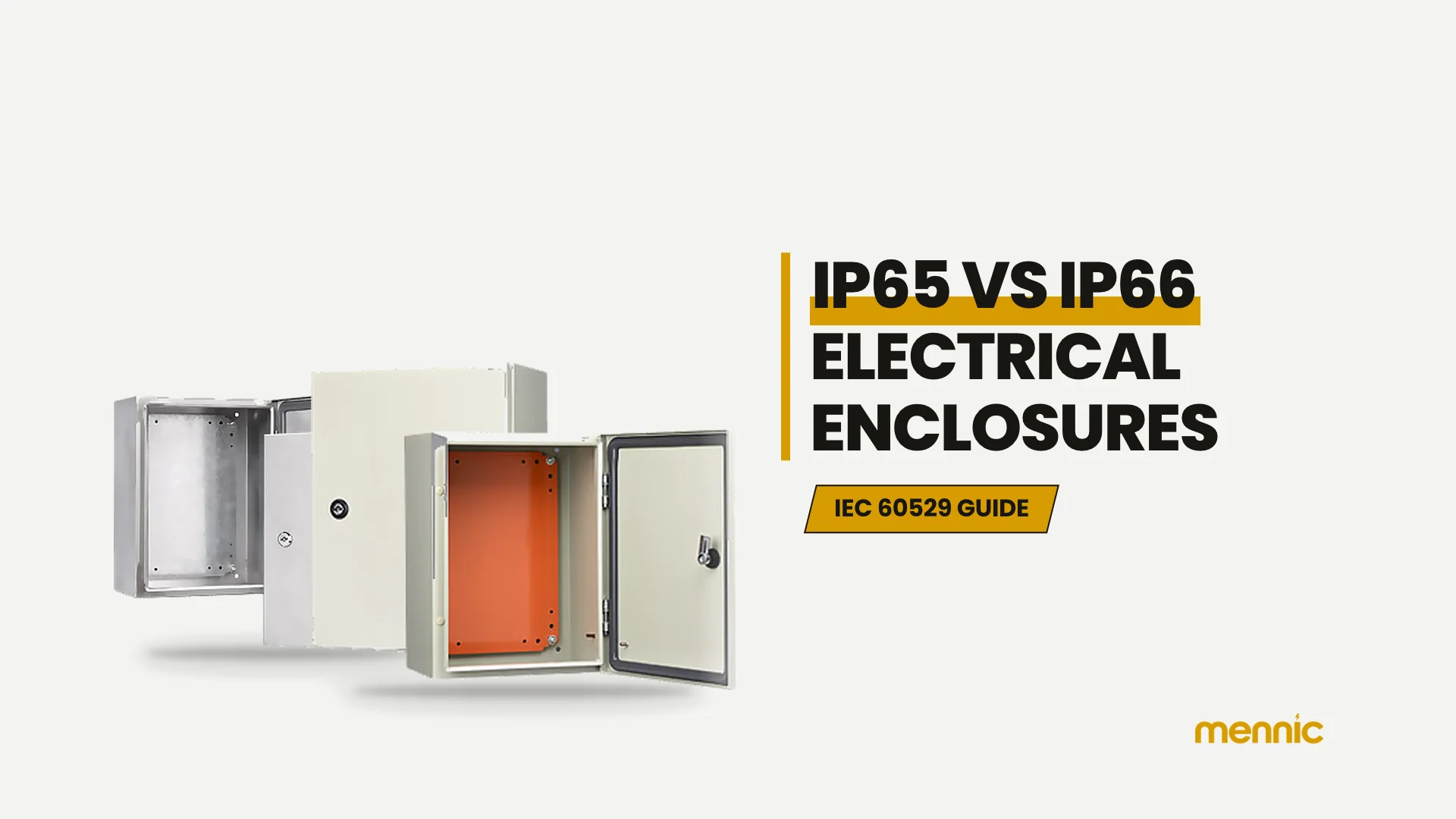
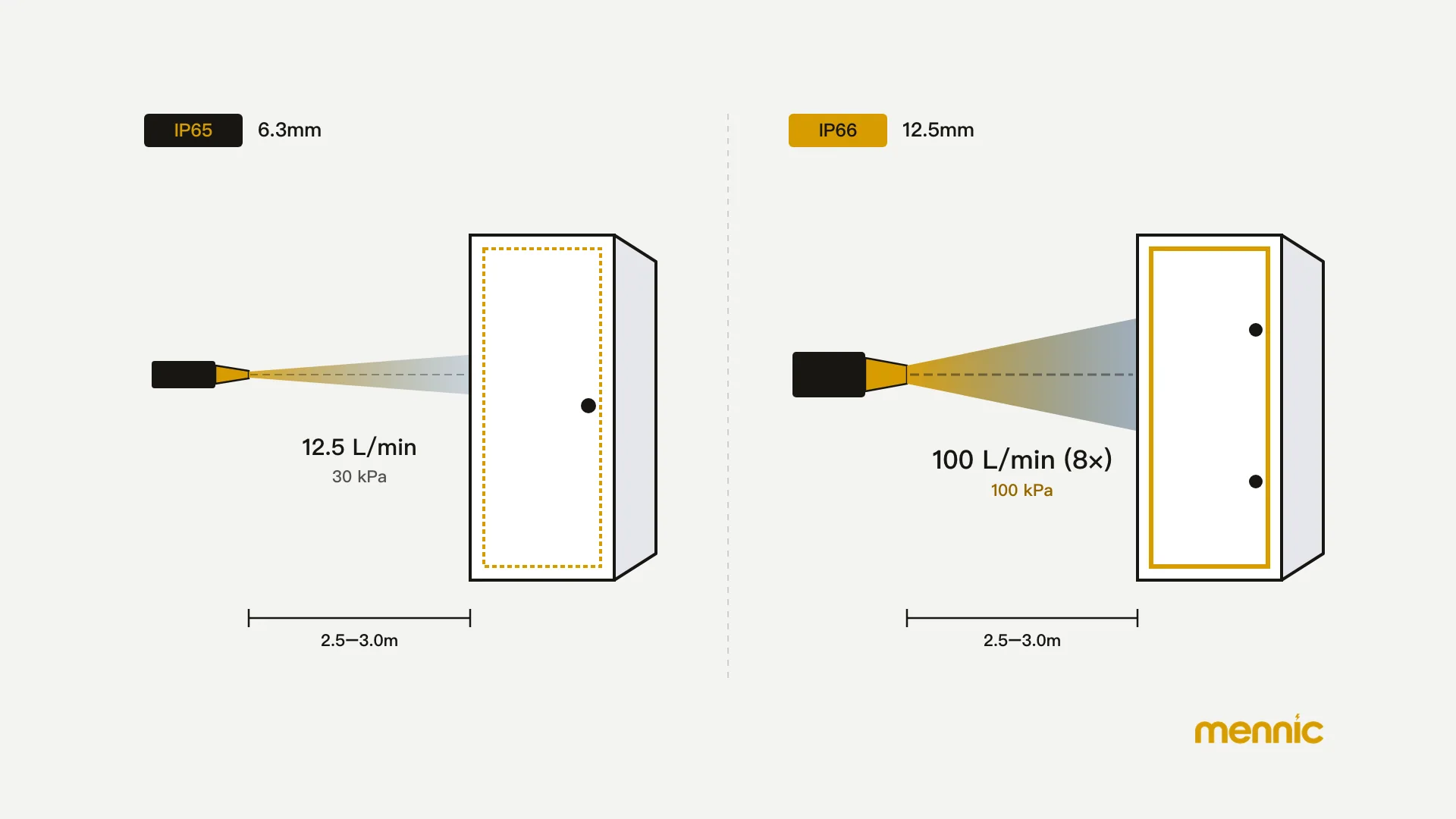
IP65 and IP66 electrical enclosures share identical dust-tight protection (first digit 6 under IEC 60529), but IP66 withstands eight times the water delivery rate of IP65—100 L/min through a 12.5 mm nozzle versus 12.5 L/min through a 6.3 mm nozzle at 2.5 to 3 meters. Choosing correctly prevents moisture ingress in coastal, storm-exposed, or washdown installations without overspecifying indoor switchgear cabinets.
For panel builders, OEM machine manufacturers, and EPC contractors, the jump from IP65 to IP66 is not merely a label change. It dictates door-frame gutter geometry, foamed polyurethane gasket compression, lock spacing on tall doors, and whether powder-coated steel, AISI 304/316 stainless steel, or polycarbonate plastic is the right housing material.
IEC 60529 Hydraulic Differences Between IP65 and IP66
Under IEC 60529, the first numeral 6 confirms complete protection against dust ingress under vacuum-assisted talcum testing for both ratings, whereas the second numeral separates low-pressure water jets (IPX5) from powerful high-volume jets (IPX6). Because IPX6 delivers 100 L/min at roughly 100 kPa compared with 12.5 L/min at roughly 30 kPa for IPX5, the dynamic force hitting door seams and latch shafts increases substantially.
| IEC 60529 Test Parameter | IP65 (Dust-Tight + Water Jets) | IP66 (Dust-Tight + Powerful Jets) | Engineering Implication for Panel Builders |
|---|---|---|---|
| Solid particle protection (first digit) | 6 — Complete dust-tight seal | 6 — Complete dust-tight seal | Both prevent conductive dust bridging on 400 V busbars and relays |
| Nozzle inner diameter (mm) | 6.3 mm | 12.5 mm | Wider jet blankets full hinge and lock zones simultaneously |
| Water delivery flow rate (L/min) | 12.5 L/min (±5%) | 100 L/min (±5%) | 8× higher water volume stresses door gutter drainage capacity |
| Approximate nozzle pressure (kPa) | ~30 kPa at 3 m | ~100 kPa at 3 m | Higher impact pressure deflects under-supported thin doors |
| Test distance (m) | 2.5 m to 3.0 m | 2.5 m to 3.0 m | Simulates directed washdown hoses and wind-driven storm rain |
| Minimum test duration | 1 min/m² (min 3 min) | 1 min/m² (min 3 min) | Sustained flow exposes pinholes at mitered gasket joints |
In practice, IP65 covers indoor factory floors, commercial basements, and sheltered exterior walls, while IP66 is the engineering baseline for unshielded outdoor poles, heavy monsoon or typhoon rainfall, marine decks, and washdown processing lines.
Door Frame Geometry, PU Gaskets, and Lock Compression Mechanics
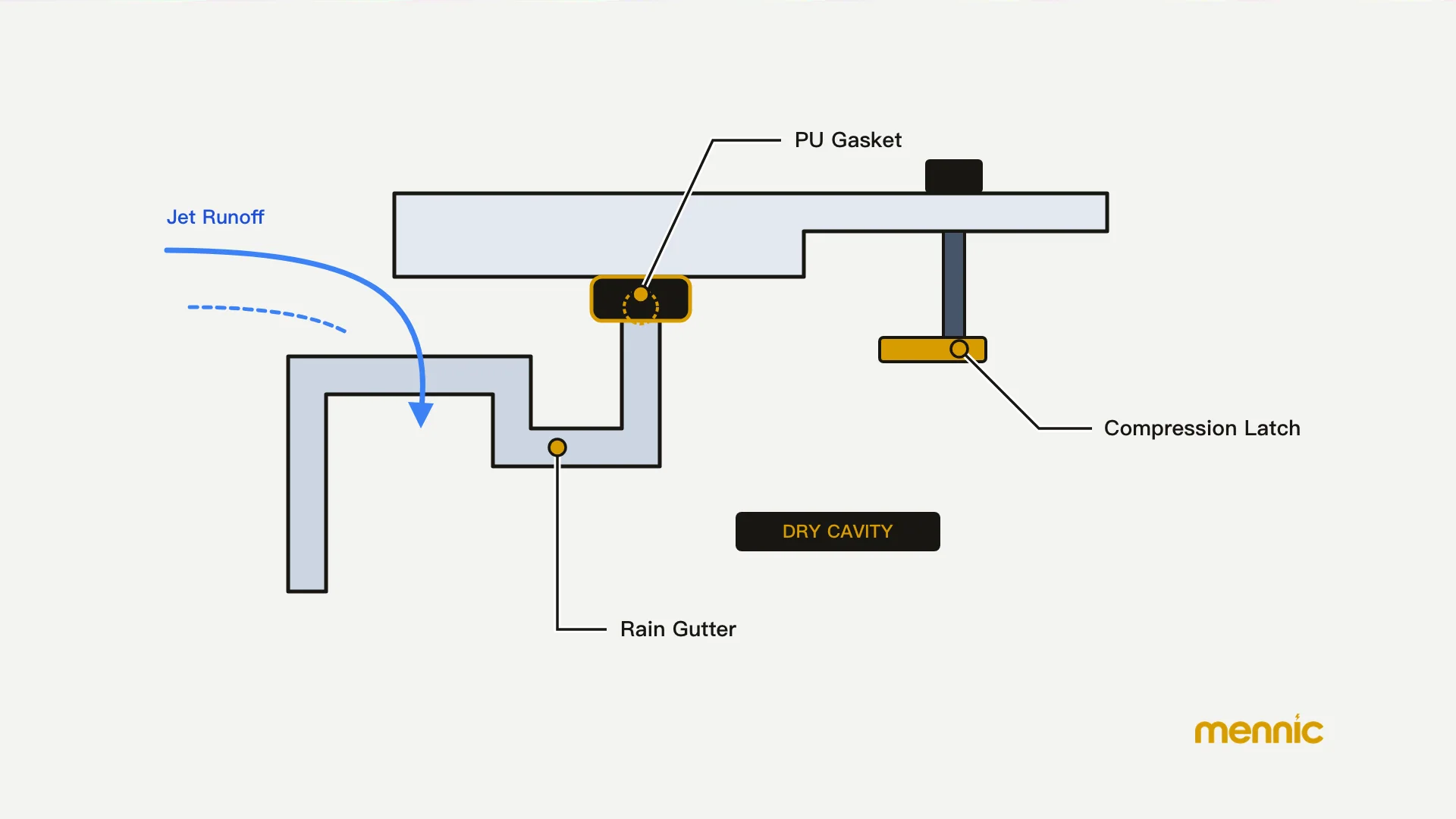
An empty electrical enclosure designed to IEC 62208:2023 achieves repeatable IP65 or IP66 sealing only when three mechanical elements work together: a folded rain-gutter lip around the cabinet opening, a continuous foamed-in-place polyurethane (PU) door gasket, and sufficient lock compression to hold gasket deflection uniform across the full door perimeter. If any one element is weak, high-velocity IP66 jets force water past the seal at mid-span between locks.
- Folded Rain-Gutter Lip: Forming a double-folded perimeter channel around the body opening creates a raised knife-edge that bites evenly into the PU gasket while channeling runoff away from the seal line when the door is opened in wet weather.
- Continuous Foamed-in-Place PU Gasket: Unlike hand-glued foam tape strips that leave weak corner butt joints, poured-in-place PU gaskets cure as one seamless loop with predictable rebound across repeated door opening cycles.
- Multi-Point Lock Spacing: Compact wall cabinets (such as 200×200×150 mm to 400×300×200 mm) seal evenly with one quarter-turn cam lock, whereas taller cabinets (600 mm height and above) require two or three locks—or a three-point rod latch—so the upper and lower door corners cannot lift under 100 L/min jet pressure.
- Concealed vs External Hinges: Recessed hinges with removable pins keep the gasket path completely uninterrupted around the hinge side, preventing capillary wicking along fastener holes.
Material and Enclosure Family Selection: IP65 vs IP66
Ingress protection alone does not guarantee outdoor durability because IEC 60529 water-jet tests evaluate clean freshwater ingress—not UV degradation, salt-spray corrosion, or mechanical impact (IK rating under IEC 62262). Selecting the right housing material alongside the IP rating prevents premature coating failure or brittle cover cracking in the field.
| Operating Environment | Recommended IP Rating | Best-Fit Housing Material | Matching Mennic Enclosure Family |
|---|---|---|---|
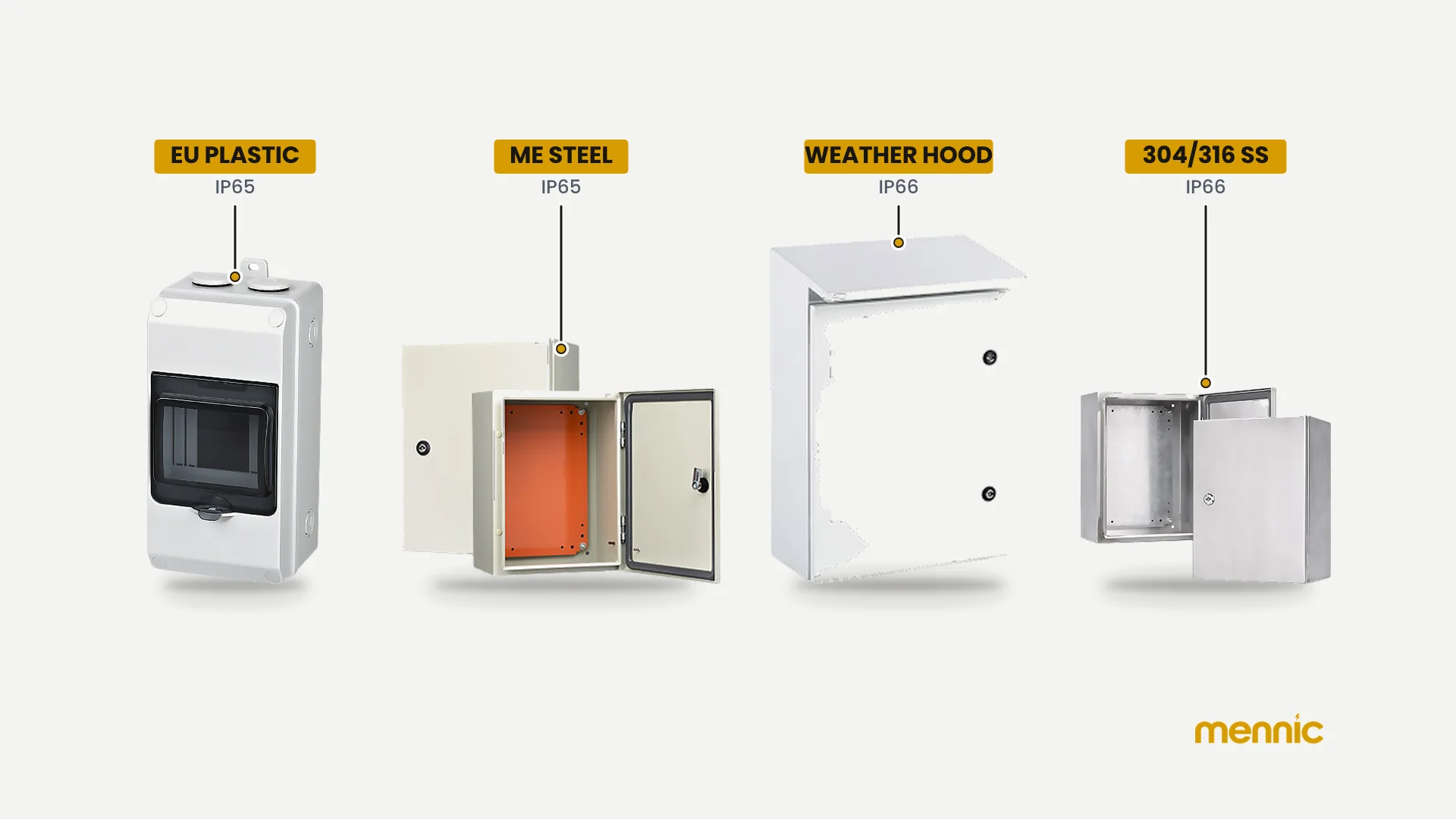
| Indoor automation & commercial sub-distribution | IP65 | Cold-rolled steel (RAL 7035) or halogen-free ABS/PC | Single Door Wall Mounting Enclosure / IP65 Surface Distribution Boxes |
| Sheltered outdoor walls & commercial parking | IP65 | ABS body with UV-stable polycarbonate transparent lid | HT Distribution Box / HA Distribution Box / TSM Distribution Box |
| Exposed outdoor rain & wind-driven storms | IP66 | Powder-coated steel with sloped top weather hood or SMC fiberglass | Outdoor Weather Hood Enclosure / Fiberglass Wall Mounting Enclosure |
| Food processing, washdown, and coastal salt air | IP66 | Brushed AISI 304 or marine-grade AISI 316 stainless steel | Stainless Steel Enclosure / Stainless Steel Terminal Box |
| Wide control panels (800–1200 mm) in narrow aisles | IP65 | Powder-coated cold-rolled steel (double-door frame) | Double Door Wall Mounting Enclosure |
When matching enclosures to corrosive coastal or washdown plants, pair IP66 sealing with AISI 304/316 stainless steel or SMC fiberglass rather than relying on painted carbon steel, because a single installation scratch on painted mild steel can initiate rust creep beneath the gasket seat.
Five Field Installation Mistakes That Downgrade IP65 and IP66 Enclosures
Even an enclosure manufactured and verified to IP66 can fail in the field during its first storm if installation practices violate the sealing boundary. Panel shops and site electricians should enforce five commissioning checks before energizing equipment:
- Drilling Cable Entries Through the Top Roof: Top-side cable glands sit in standing water and rely entirely on the gland O-ring to hold back gravity-fed moisture. Always route incoming and outgoing cables through the bottom removable gland plate or lower knockouts on IP65 electrical enclosures and IP66 electrical enclosures.
- Mounting Through the Rear Wall Without Sealing Washers: Drilling four unsealed anchor holes directly through the back panel bypasses the door gasket completely. Use external wall-mounting brackets bolted into blind factory bosses or EPDM-backed sealing washers.
- Mixing Undersized Cable Glands or Leaving Open Knockouts: An enclosure’s installed protection equals its weakest penetration. Every cable entry must match the cable outer diameter within the gland’s clamping range, and unused knockouts must remain sealed with rated blanking plugs.
- Ignoring Thermal Pressure Swings and Condensation: Sealed IP65 and IP66 cabinets exposed to daytime solar heating followed by sudden cold rain experience an internal vacuum drop that draws humid air through microscopic micro-paths. On exposed outdoor installations, add a bottom-mounted IP66 breather drain plug to equalize pressure and vent condensate safely.
- Over-Cutting Viewing Windows or Door Pushbuttons Without Gasketed Bezels: Field-cut HMI and meter openings require clean deburred edges and IP65/IP66-rated panel-mount bezels; otherwise, water sheeting down the front door enters behind the bezel lip.
Quick Selection Checklist: Specifying IP65 vs IP66 for Your Project
Before issuing an RFQ or selecting from a standard dimensional table, confirm these four site parameters:
- Water Exposure Profile: Choose IP65 for indoor dust, accidental splashes, and light maintenance wiping; specify IP66 for direct outdoor rain, hose-down cleaning, or coastal wind-driven spray.
- Housing Material Compatibility: Use powder-coated cold-rolled steel (RAL 7035) for indoor automation panels, ABS/polycarbonate for lightweight 4-way to 24-way DIN-rail distribution boxes (such as Mennic EU, HT, HA, and TSM series), and AISI 304/316 stainless steel or Fiberglass / SMC enclosures for corrosive outdoor duty.
- Thermal & Dimensional Margin: Reserve 20% to 25% spare mounting-plate area and confirm depth clearance for MCCBs, VFDs, or door-mounted indicators—note that sealed IP65/IP66 cabinets dissipate heat through surface area rather than open louvers.
- Cable Entry & Mounting Hardware: Specify removable bottom (or top-and-bottom) gland plates and factory-installed mounting plates to eliminate overhead field drilling and preserve factory sealing integrity.
Need dimensional tables or custom CNC cutouts for an upcoming IP65 or IP66 panel build? Explore the complete Mennic Wall Mounting Steel Enclosures and Plastic & Polycarbonate Enclosures catalogs, or review common engineering answers on our Electrical Enclosure FAQ.
Frequently Asked Questions
Is an IP66 electrical enclosure always better than IP65?
IP66 provides stronger protection against powerful 100 L/min water jets than IP65 (12.5 L/min), making it superior for exposed outdoor walls and washdown plants. However, for dry indoor control rooms or sheltered commercial corridors, IP65 delivers identical dust-tight protection at lower hardware cost without over-engineering the door latch and gasket assembly.
Does IP66 protect an electrical enclosure against temporary submersion or flooding?
No. Under IEC 60529, IP66 covers powerful water jets from any direction, not immersion. An IP66 enclosure is not automatically rated for standing floodwater or submersion—those conditions require IP67 (temporary immersion up to 1 m for 30 min) or IP68 (continuous immersion under agreed conditions).
Can a double-door wall-mounting cabinet maintain IP65 or IP66 sealing?
Double-door enclosures reliably achieve IP65 when fitted with a rigid center mullion or overlapping astragal gasket and multi-point latches. For harsh IP66 outdoor washdown duty where continuous single-perimeter gasket compression is critical, single-door cabinets with rain-gutter frames generally provide higher long-term sealing margin.
References
- IEC 60529: Degrees of protection provided by enclosures (IP Code) — IEC Webstore
- IEC 62208:2023: Empty enclosures for low-voltage switchgear and controlgear assemblies — IEC Webstore
- IEC 62262: Degrees of protection provided by enclosures for electrical equipment against external mechanical impacts (IK code) — IEC Webstore
Need help selecting the right enclosure?
Browse Enclosures
Explore our complete catalog of IP65/IP66 steel wall mounting cabinets and waterproof plastic distribution boxes.